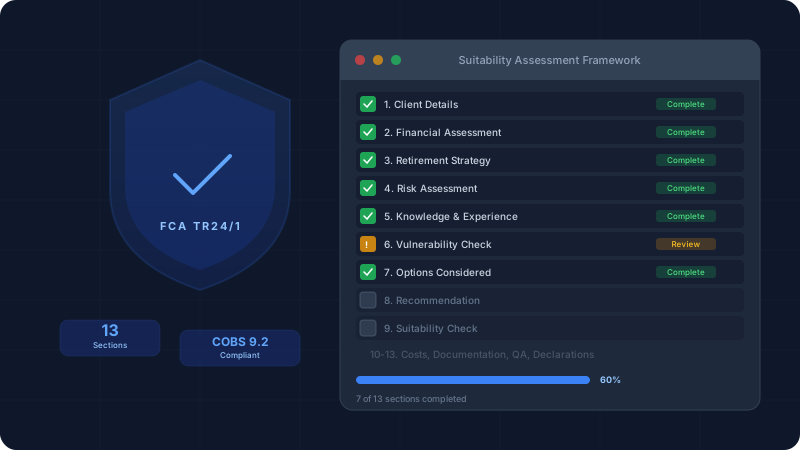
Thematic Review
Structured guidance and evidence-ready outputs.
TR24/1 decoded: what the FCA's retirement income review means for your firm
The FCA reviewed 977 firms and found 33% of files incomplete, 54% of registers inaccurate. What TR24/1 means for your firm and what to do next.
By Plannetic Research
Highlights
Files reviewed
100
Across 24 firms, covering drawdown, annuity and mixed scenarios.
Register accuracy
46%
Only 46% of advice registers were fully accurate.

Missed reviews
6,108
Customers who paid for ongoing reviews but didn't receive one.
What TR24/1 is and why it matters
In March 2024 the FCA published TR24/1, the most detailed regulatory examination of retirement income advice since pension freedoms were introduced in 2015. The review covered 977 firms through a data survey, carried out in-depth centralised retirement proposition (CRP) reviews at 24 firms, and assessed 100 individual advice files. The work took place between 2022 and 2023, and its findings set out the FCA's expectations for every firm advising clients on drawdown, annuity purchase, or a combination of the two.
The backdrop is important. Since pension freedoms shifted investment and longevity risk from pension providers to individuals, the FCA has been concerned that the quality of advice has not kept pace with the complexity of the decisions clients are being asked to make. Drawdown clients face sequence-of-returns risk, inflation erosion of purchasing power, and the possibility of outliving their savings — risks that accumulation-phase investors simply do not face. TR24/1 asks whether advisers and their firms have adapted their processes to match this shift.
This is not general guidance or a consultation. A thematic review is a regulatory signal — it tells the industry where the FCA has found problems and, by implication, where enforcement attention may follow. Firms that treat TR24/1 as a voluntary read risk finding themselves on the wrong side of the next supervisory cycle. Firms that engage with the findings and act on them have an opportunity to materially improve their advice quality and regulatory standing.
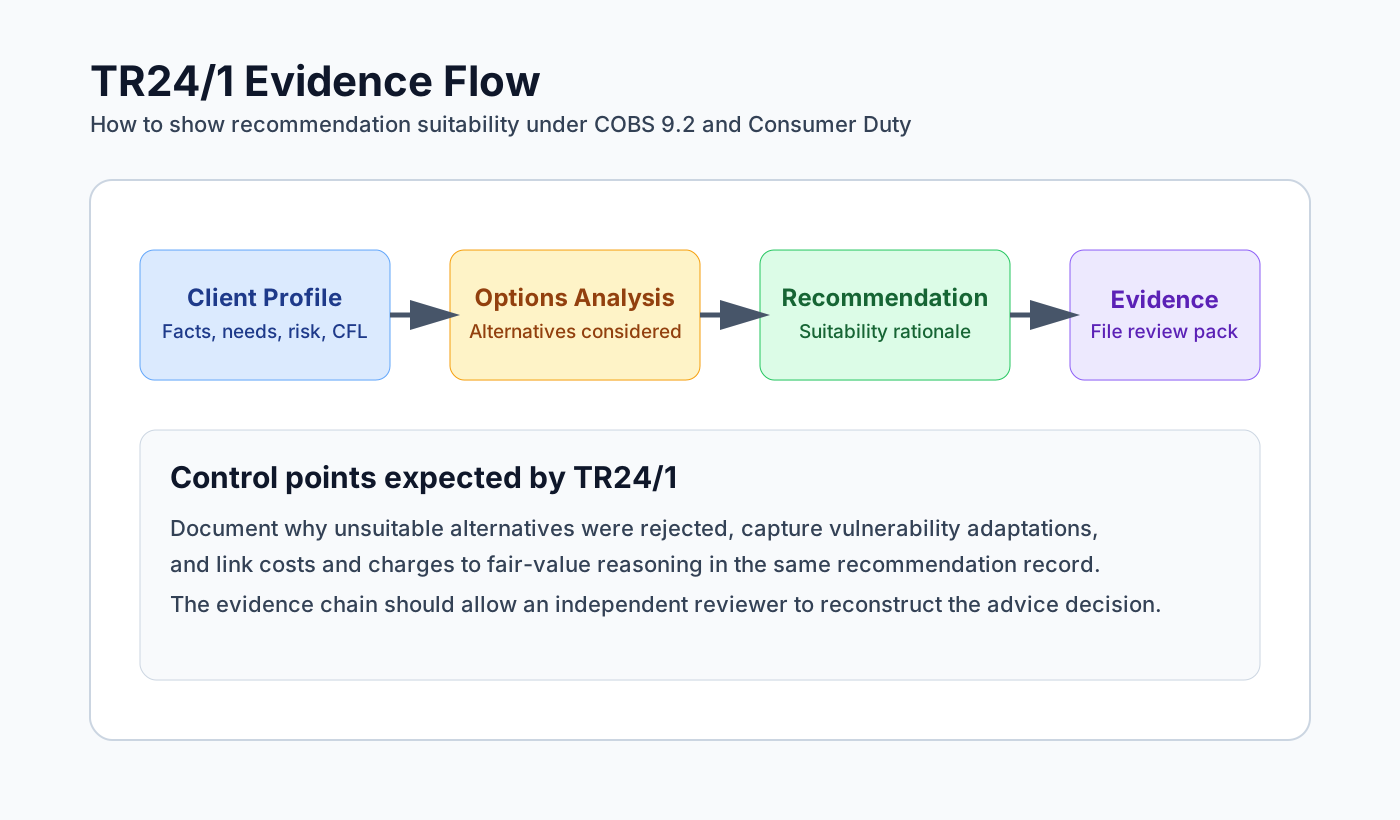
The ten key findings
The findings fall into three groups: file quality, process design, and control effectiveness. On file quality, the FCA found that 33% of the 100 files reviewed had missing documents or significant information gaps (paragraph 3.2). Of the 67 files that could be fully assessed, 11% raised suitability concerns — meaning the advice may not have been suitable for the client (3.8). A further 22% had material information gaps so severe that the FCA could not determine whether the advice was suitable at all (3.8). These are not marginal issues. They represent a fundamental failure to collect and record the information needed to give suitable advice.
On process design, the review found that risk profiling across all 24 firms was designed for accumulation, not decumulation (2.23). Attitude to risk and capacity for loss were frequently conflated rather than assessed separately as FG11/05 requires. Only 46% of advice registers were fully accurate (2.35), with some so unreliable that the FCA could not match recorded data to actual files. A total of 6,108 customers had paid for ongoing reviews but did not receive one (2.27). Cashflow modelling tools were used by 765 of the 977 firms, but application was inconsistent — some firms quoted headline probabilities without explaining what happened if the client lived beyond average life expectancy (2.14).
On control effectiveness, the picture was equally stark. Firms' own QA processes had checked many of the same files the FCA reviewed but failed to catch the issues the regulator found (2.36). Only 50% of firms had carried out proper due diligence on their third-party tools (4.27). Vulnerable customer policies existed on paper but were not consistently applied in practice (4.50). Taken together, these findings describe an industry where the processes and controls have not adapted to the complexity of the product they are meant to govern.
What the FCA expects firms to do
The FCA is not asking firms to complete a tick-box exercise. TR24/1 makes clear that compliance requires structural change, not cosmetic adjustment. At the centre of the regulator's expectations is a well-designed centralised retirement proposition with decumulation-specific processes. This means separate assessment of attitude to risk and capacity for loss, with investment solutions aligned to the lower of the two. It means cashflow modelling that includes stress testing for poor sequence of returns, longevity beyond average life expectancy, and the erosion of purchasing power through inflation.
Firms must ensure that fact-finds are complete before advice is given — not populated after the event. The information collected should cover income needs (essential and discretionary), expenditure patterns that reflect likely post-retirement changes, knowledge and experience, health factors that affect longevity assumptions, state pension entitlement and timing, tax position, and means-tested benefit exposure. Advice registers must be accurate, centrally maintained, and capable of generating management information without manual extraction from individual files.
Under Consumer Duty, the FCA expects firms to monitor and evidence customer outcomes across all four pillars: products and services, price and value, consumer understanding, and consumer support. TR24/1's findings on register accuracy and MI quality make clear that most firms cannot currently do this. The firms that close this gap first will not only reduce their regulatory risk — they will build a demonstrable competitive advantage in a market where clients, networks, and platforms are increasingly scrutinising the quality of advice they receive.
How technology closes the gap
The root cause of most TR24/1 failures is manual process. When fact-finds are Word documents, advisers can skip fields. When advice registers are spreadsheets populated after the event, data accuracy depends on the diligence of the person entering the information. When QA is a retrospective review of completed files, it catches problems too late — after the client has already received the advice and the firm has already taken on the liability.
Structured digital fact-finds with mandatory fields and completeness gates prevent information gaps at source. When a field is required before the process can progress, the 33% of files with missing information becomes operationally impossible. Automated audit trails that log every action — fact-find completion, risk assessment, suitability report generation, client approval — create advice registers that are accurate by design rather than by discipline. Integrated cashflow modelling with Monte Carlo simulation and stress testing produces consistent projections regardless of which adviser runs the analysis.
Automatic review scheduling with escalation rules eliminates the gap that allowed 6,108 clients to pay for reviews they did not receive. Platform-generated management information — file quality trends, review completion rates, outcome metrics — gives boards the data they need to demonstrate Consumer Duty compliance without manual collation from multiple sources. This is not a technology pitch. It is an operational reality: the problems the FCA found are process problems, and process problems require process solutions. The question for each firm is whether to solve them with better spreadsheets or with purpose-built infrastructure.
What to do next
Three priorities emerge from TR24/1 for any firm advising on retirement income. First, audit your advice register accuracy. Pull a sample of files and check whether the register data matches the actual advice given. If you find discrepancies — and most firms will — this tells you your MI is unreliable and your Consumer Duty monitoring is built on sand. The fix is to move from retrospective data entry to automatic population from the advice process itself.
Second, review your risk profiling for decumulation bias. Read your ATR questionnaire as if you were a 67-year-old entering drawdown rather than a 40-year-old building a pension. If the language is about growth, accumulation, and investment horizons of 10+ years, it is not fit for purpose. Separate ATR from CFL, add decumulation-specific questions on income needs, health, and state pension timing, and implement the lower-of calculation for investment alignment.
Third, check your fact-find completeness. Not whether the template has the right fields, but whether those fields are actually completed before advice is given. If your process allows an adviser to proceed with an incomplete fact-find, you have a structural gap that QA cannot fix retrospectively. The answer is a hard stop — a process that prevents progression until the required information is captured and validated.