Service Value
Structured guidance and evidence-ready outputs.
Ongoing service value under Consumer Duty: proving advice is delivered, not just charged
A commercial and compliance playbook for evidencing ongoing service value, reducing refund exposure, and protecting long-term client trust.
By Plannetic Research
Highlights

Delivery proof
Traceable
Every promised service can be mapped to a completed action and client outcome.

Value coverage
89%
Typical coverage target for completed annual service commitments.

Refund risk floor
Low
Structured remediation controls reduce unresolved fee-value exceptions.
Why ongoing service is now a measurable value obligation
For advisory firms, ongoing service is no longer a soft promise attached to an annual review letter. Under Consumer Duty, it is a measurable value obligation. If fees continue while delivery is inconsistent, firms create a direct price-and-value exposure that is both commercial and regulatory.
The commercial impact arrives before enforcement. Clients notice weak contact cadence, incomplete review outcomes, or generic communications that do not reflect their plan status. Confidence falls, attrition risk rises, and advisory teams are forced into reactive remediation. The core operating objective is to show, at file level, that promised service was actually delivered and delivered on time.
Evidence architecture: from promise to client outcome
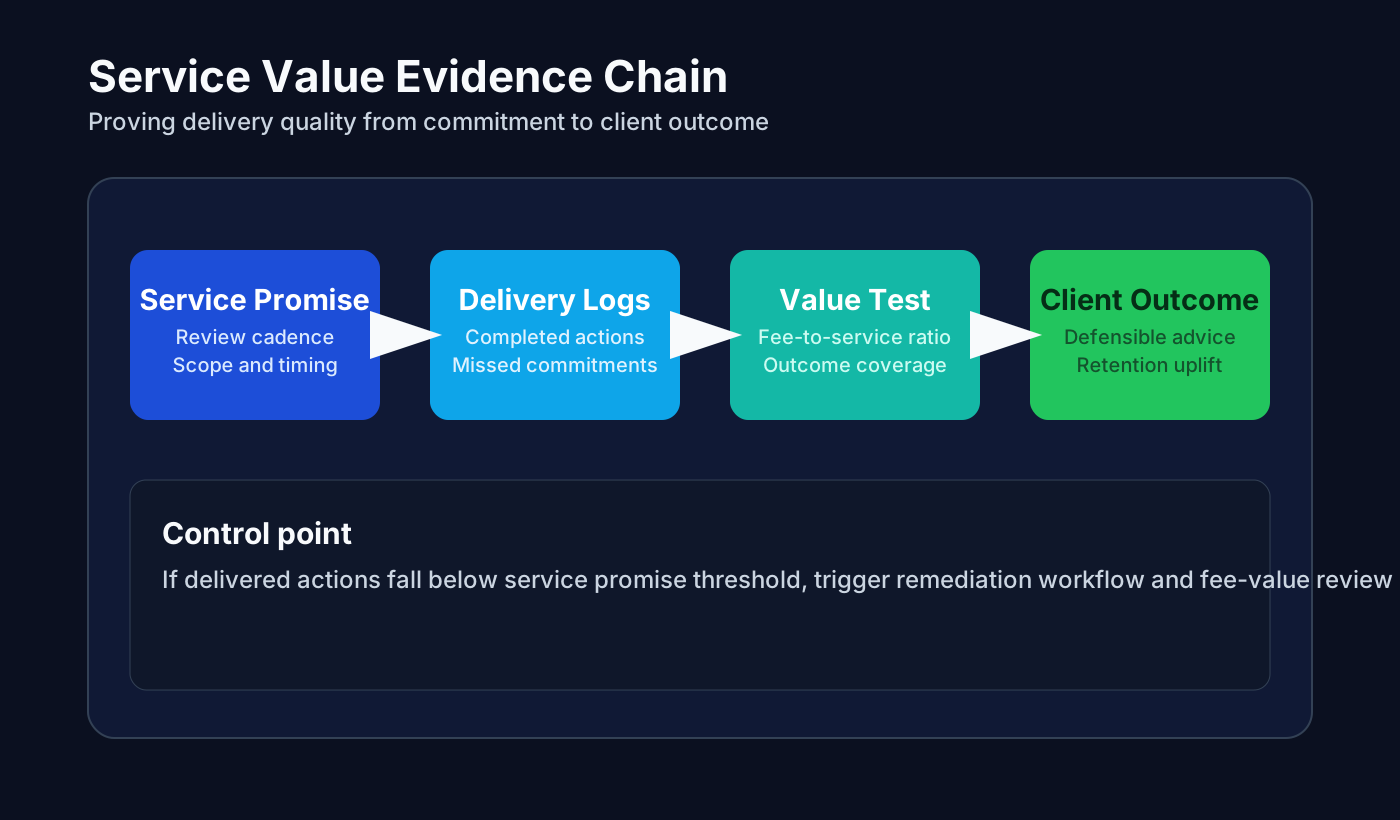
A defensible operating model starts with explicit service promises: review frequency, scope, response standards, and support commitments. Those promises should map to delivery logs, then to outcome evidence such as completed actions, updated recommendations, and client communications.
When that chain is visible, compliance reviews move from narrative judgement to objective verification. Teams can quickly identify where service fell below threshold and whether client impact was material.
Measuring exposure before complaints escalate
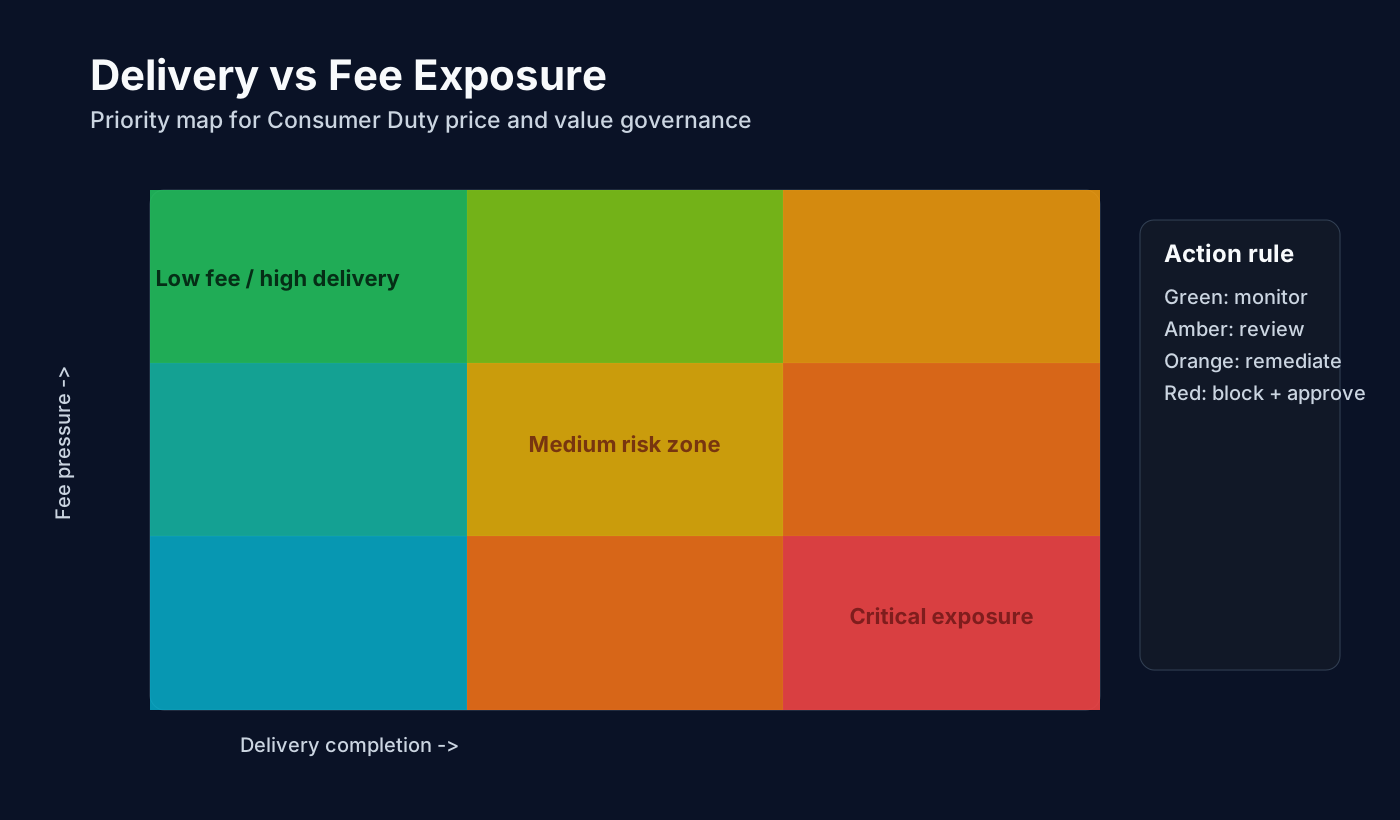
Firms should monitor service-completion and fee-pressure together, not as separate datasets. A high-charge segment with low completion rates is a priority risk zone, especially where vulnerable clients are present or service commitments include complex planning events.
This risk mapping is commercially useful because it prioritises intervention where trust erosion is most likely. The goal is to fix delivery quality before a client raises a value challenge.
Remediation controls and governance response
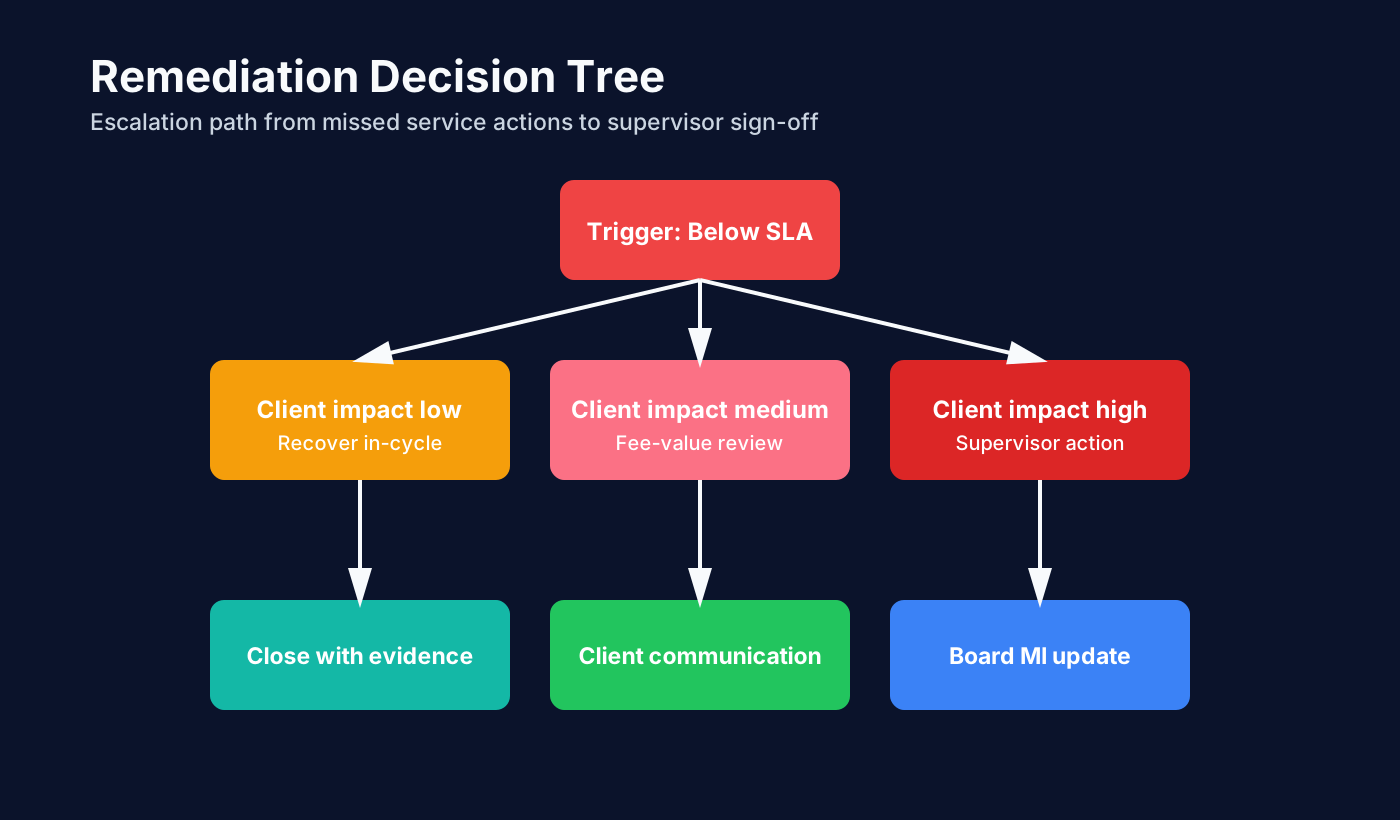
When a threshold breach occurs, response quality matters as much as detection quality. Low-impact misses can be recovered in cycle, while medium-impact cases require fee-value review and explicit client communication. High-impact breaches should route through supervisor approval with recorded justification and closure evidence.
A structured remediation tree improves consistency across advisory teams and creates clear board-level reporting on unresolved exceptions.
Ninety-day implementation playbook for firms
In the first month, define service commitments and the minimum evidence fields required for closure. In the second month, deploy completion-rate and fee-pressure MI with escalation thresholds. In the third month, run supervisor calibration on medium and high-impact cases to standardise intervention.
This cadence gives firms a practical route to improve value evidence quickly without redesigning the full advice stack in one release.