
Monte Carlo Engineering
Structured guidance and evidence-ready outputs.
Monte Carlo engineering inside Plannetic: from scenario inputs to decision-grade outputs
A technical editorial on sequence-of-returns risk, model design, and why compliance-grade suitability now requires stress-tested evidence rather than linear-growth assumptions.
By Plannetic Quant Research
Highlights
Simulation depth
Path-based
Each run projects annual wealth path, drawdown, and terminal state.
Decision outputs
10 metrics
Success, shortfall, confidence bands, drawdown, volatility and depletion signals.

Validation pack
80 tests
Deterministic, stochastic, stress and API consistency checks.
Consumer Duty and Model Transparency
Most retirement clients do not ask advisers to explain stochastic calculus. They ask whether their planned income can survive adverse market timing, inflation pressure, or a prolonged downturn at the start of drawdown. Today, that highly practical question is also a strict regulatory mandate. Under the FCA Consumer Duty, firms must evidence that recommendations are understandable, suitable, and likely to deliver good outcomes, not merely plausible under favourable assumptions.
That changes the role of Monte Carlo modelling. It cannot sit in the background as a black-box percentage that is difficult to explain in plain language. In Plannetic, the simulation engine is positioned as evidence-backed decision support. The objective is to give advisers outputs that can be communicated to clients, challenged by compliance teams, and defended in suitability files without overstating certainty.
Engine Depth and Data Lineage
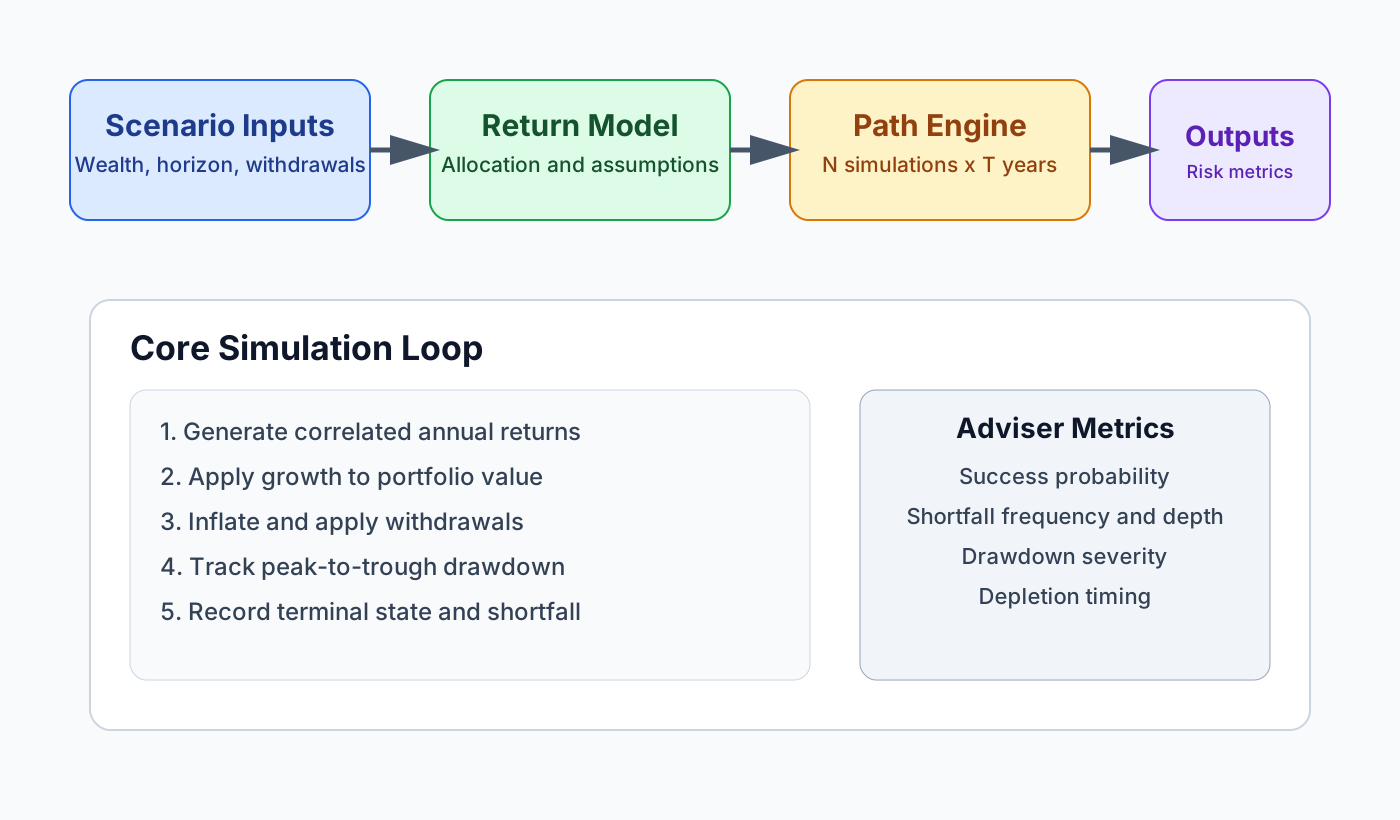
The quality of any simulation output is determined by input integrity and processing order. Plannetic begins with adviser-specified planning assumptions: current asset values, pension balances, intended withdrawals, retirement horizon, inflation assumptions, and allocation structure. Those inputs are normalised and passed into a path-based engine that projects annual wealth states, not just an endpoint figure. Each iteration tracks returns, withdrawals, and balance transitions year by year.
After path generation, an aggregation layer calculates decision metrics that advisers can use directly in recommendation discussions: success frequency, shortfall magnitude, depletion timing, drawdown severity, and percentile confidence bands. The API maps those metrics into review-ready outputs used in the platform and documentation workflow. This lineage matters because defensible advice depends on traceability from client assumptions to model output, not simply model output to recommendation text.
Sequence of Returns Risk: The Flaw in Linear Growth
A linear growth model can look reassuring while concealing structural fragility. If a plan is tested against one deterministic return line, the adviser can miss the most damaging real-world pattern: poor returns arriving early while withdrawals are fixed or rising with inflation. Sequence-of-returns risk is therefore not a peripheral concern; it is central to retirement sustainability because losses at the beginning of decumulation reduce the capital base from which recovery must occur.
Plannetic models this explicitly inside the yearly processing order. For each simulated year, correlated returns are applied, withdrawals are escalated where required, and portfolio value is updated before the next step is evaluated. Drawdown is tracked path by path using peak-to-trough logic, and depleted paths are marked early rather than averaged away. This is the crucial difference between a presentation model and a decision model: timing effects are preserved, not smoothed.
This is also why stress testing beyond linear assumptions is non-negotiable for modern suitability work. Advisers need to assess not only expected market variance, but clustered adverse conditions such as elevated inflation, weaker real returns, and withdrawal rigidity in the early years of retirement. A model that cannot represent those compounded conditions cannot provide reliable evidence for recommendation resilience.
Suitability: Balancing Frequency and Severity
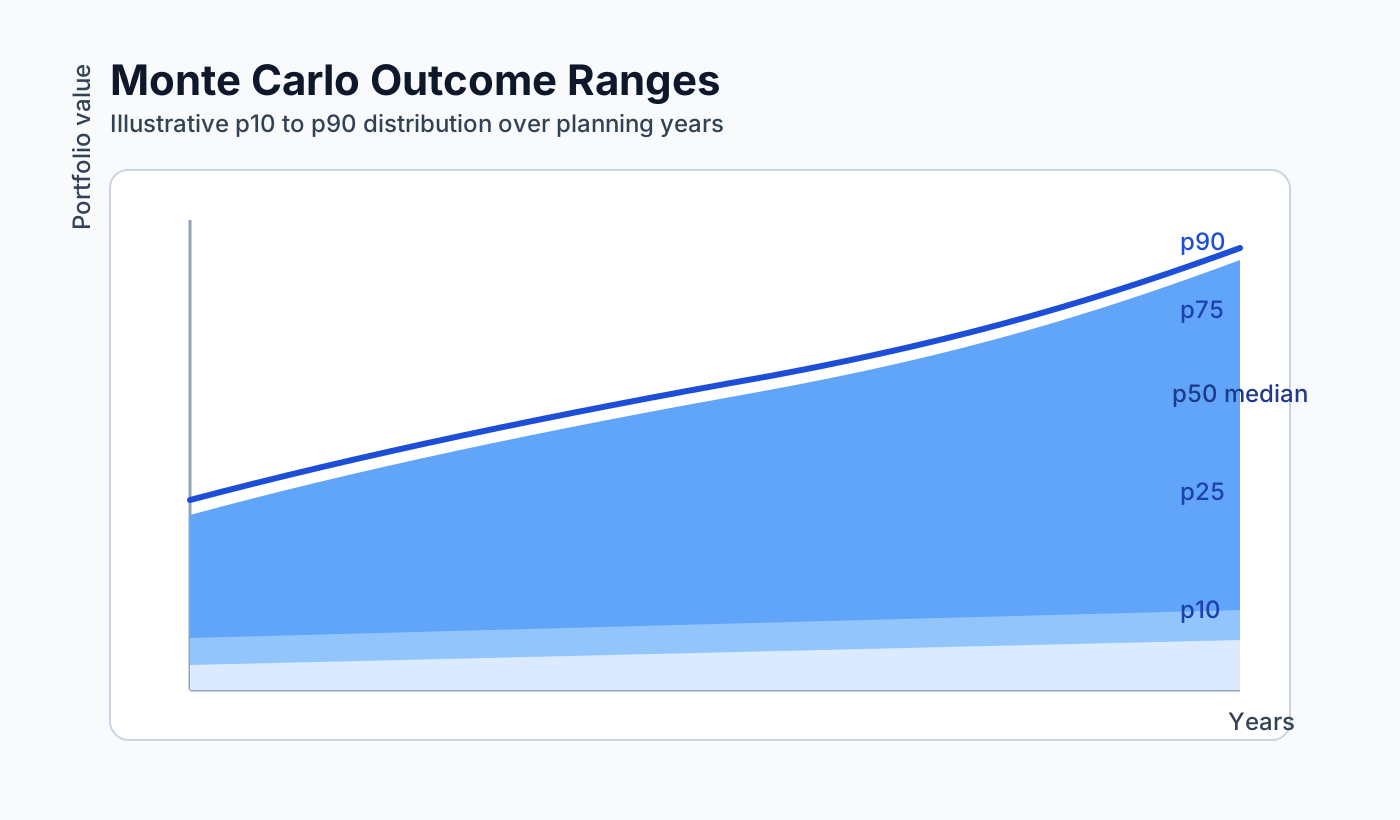
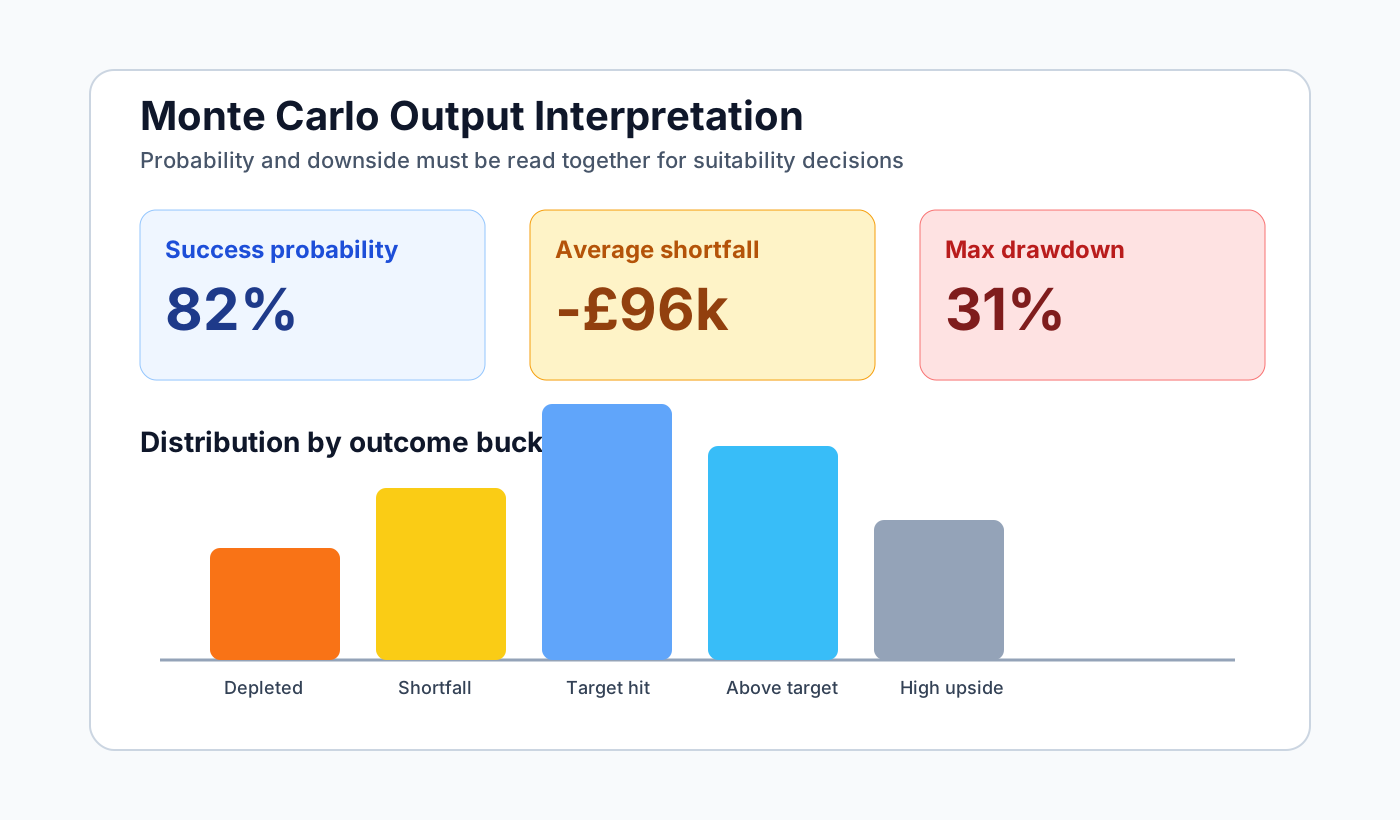
A single success percentage is an incomplete planning signal. Two plans can both report an apparently acceptable probability while carrying very different downside consequences. One may fail rarely but with severe shortfall when it does; another may fail slightly more often but with manageable recovery actions. For suitability, advisers need both dimensions visible: failure frequency and failure severity.
Confidence bands, shortfall metrics, and drawdown context should therefore be interpreted as one connected decision frame. In client conversations, this supports clearer explanations of trade-offs between current withdrawals and long-term resilience. In compliance review, it provides a documented rationale for why a recommendation was selected over alternatives. In both settings, the model output is treated as structured evidence of risk distribution, not as a promise of future returns.
Case Study: From Acceptable Probability to Defensible Recommendation
In an anonymised pre-retirement case, the client entered planning with assets just above £1 million and expected withdrawals near £52,000 per year. The initial run produced a headline success rate that could have been accepted as adequate under a traditional linear-growth mindset.
However, path-level review exposed significant vulnerability when adverse returns occurred in the early retirement window, with materially weaker terminal outcomes than the headline metric implied.
The adviser responded by adjusting plan mechanics rather than defending the original assumption set: reducing annual withdrawals, phasing inflation-linked increases, and adding a dedicated short-term liquidity reserve to reduce forced selling during stressed years. The rerun improved not only headline probability but also downside depth and depletion timing. That distinction is operationally important: the final suitability rationale documented both why the recommendation changed and which risk signals justified the change.

Model Boundaries and Governance
Robust modelling requires explicit boundaries. No Monte Carlo engine can eliminate uncertainty, and no projection should be presented as deterministic truth. Plannetic therefore treats outputs as scenario-dependent evidence shaped by defined assumptions. This includes clear acknowledgement that behaviour under stress is approximated, tax interactions are modelled within declared scope, and output quality is contingent on input quality and calibration discipline.
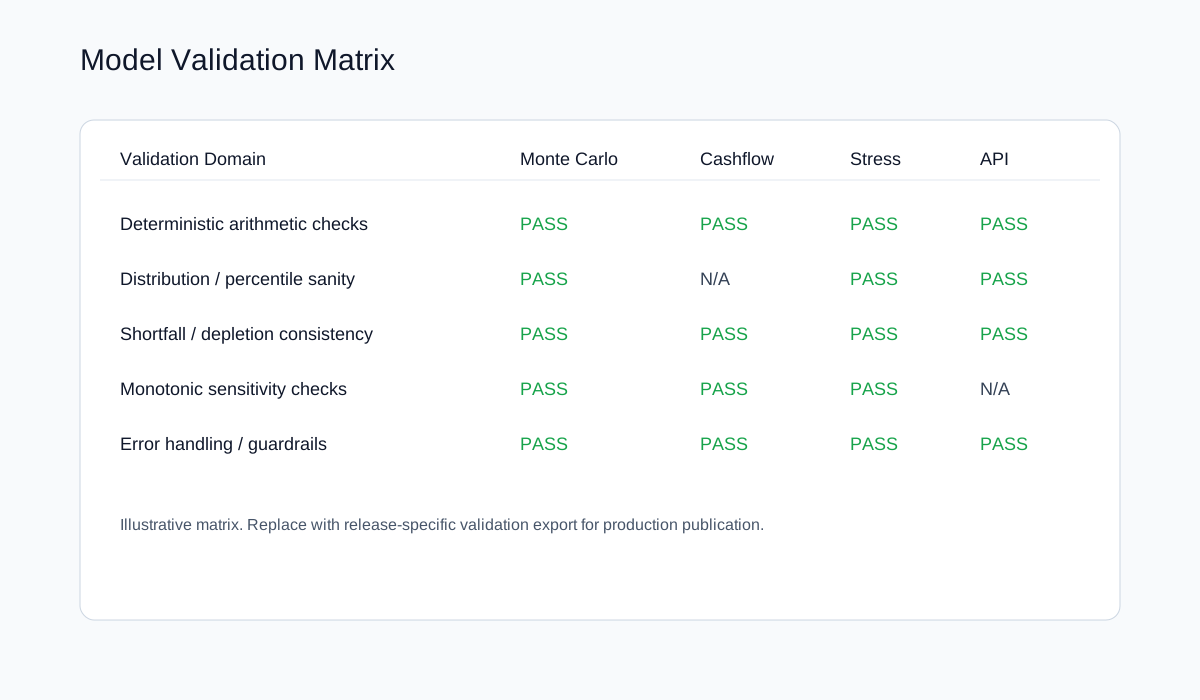
Governance is handled as an ongoing release control process rather than a one-off validation event. Deterministic arithmetic checks, stochastic sanity checks, percentile ordering checks, and interface consistency checks run as part of model assurance. Where defects are identified, fixes are locked into permanent regression tests before release. This control posture supports better engineering outcomes and stronger regulatory defensibility when recommendations are audited.
For advisory firms, the practical benefit is audit readiness. When compliance or supervisory review asks why a recommendation was made, firms can point to declared assumptions, repeatable simulation logic, preserved scenario outputs, and validated calculation behaviour. That record supports the core professional claim advisers must make to clients and regulators alike: the recommendation was reasoned, tested, and proportionate to the client's objectives and risk capacity.
What This Means for Advisory Firms
For UK advice firms, the practical standard is now clear: modelling must support client understanding and regulatory scrutiny at the same time. A plan that relies on straight-line growth may still satisfy a presentation need, but it is weak evidence for suitability when market sequencing risk is ignored. Stress-tested distributional outputs provide a more realistic basis for recommendation design and client communication.
The commercial consequence is equally direct. Firms that can explain model logic in plain language, evidence suitability in technical language, and maintain clear control boundaries in compliance language are better positioned to deliver durable client outcomes and reduce file-quality risk. Monte Carlo is not the differentiator on its own. Defensible interpretation, transparent governance, and disciplined stress testing are.