Model Governance
Structured guidance and evidence-ready outputs.
How Plannetic validates models before advice outputs: controls, tests, and release discipline
A technical governance view of model validation in Plannetic, including a release-blocking case study showing how defects are detected, fixed, and locked.
By Plannetic Model Governance
Highlights
Validation design
4 domains
Monte Carlo, cashflow, stress transforms, and API consistency.
Release control
Gate-based
Defects block release until regression coverage is in place.
Evidence quality
Traceable
Assumption, result, defect, and fix chain is auditable.
Why model controls are now a commercial requirement
Model governance is no longer only a risk-team concern. Advisory technology buyers increasingly ask whether model outputs can be trusted, reproduced, and explained to compliance and clients.
A modern planning platform needs visible controls: not only formula correctness, but repeatability, release discipline, and explicit limitations. This is now part of product quality, not optional documentation.
Validation domains used in Plannetic
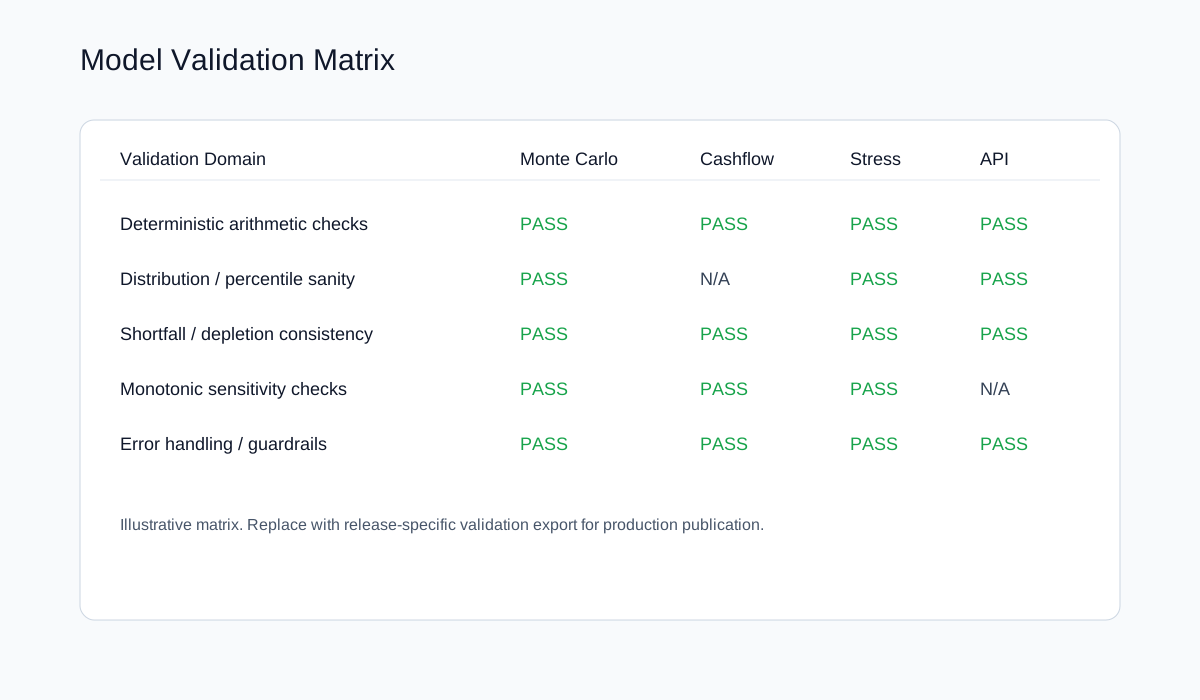
We validate four domains: Monte Carlo path maths, cashflow arithmetic and ordering, stress parameter propagation, and API output consistency.
Deterministic checks validate arithmetic. Stochastic checks validate distribution behaviour, percentile ordering, and sensitivity relationships.
Integration checks confirm semantic consistency across storage and UI layers.
Defect lifecycle: detect, fix, lock
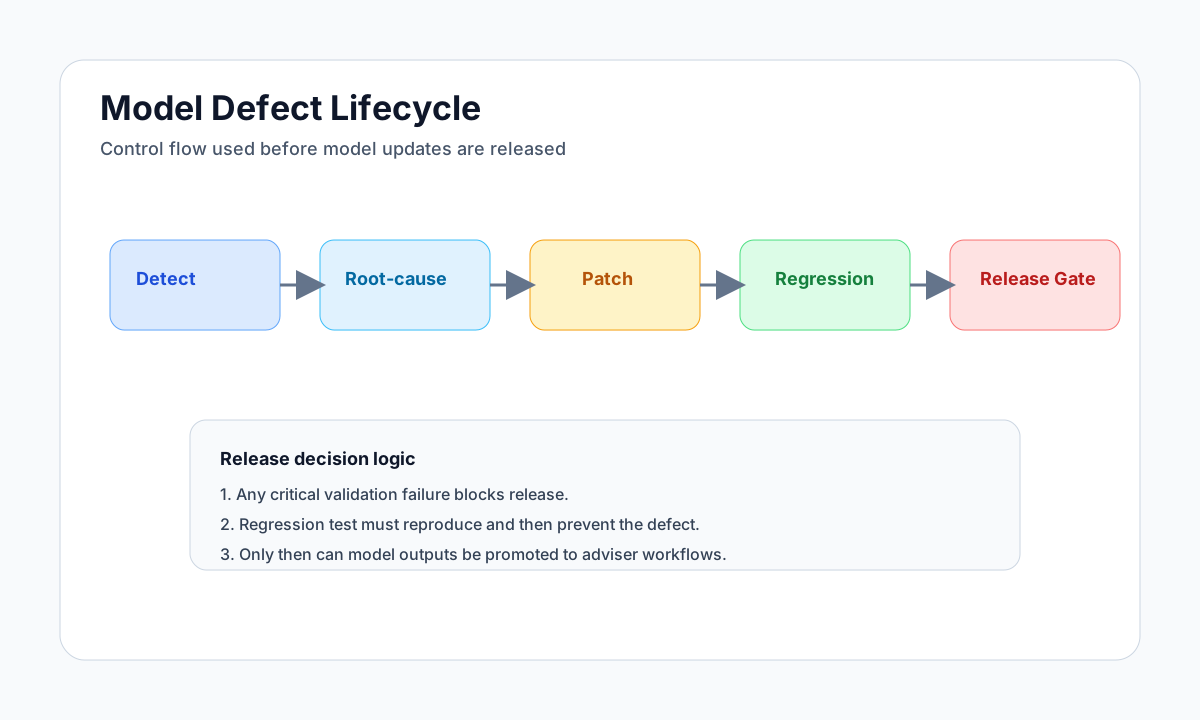
When a defect is found, the response pattern is fixed: isolate, root-cause, patch, regression-test, rerun validation, then release.
This prevents the same modelling issue from returning in later sprints.
Practical example: shortfall semantics were tightened so depleted negative terminal paths correctly contribute to shortfall magnitude, then locked with regression tests.
Case Study: Release Gate Held Until Evidence Was Complete
In a recent internal release cycle, a downside metric discrepancy appeared between simulation output and displayed recommendation context for a subset of depleted paths. The issue was not catastrophic, but it was material enough to risk understating client downside in edge cases.
Release was blocked while the team isolated the semantic mismatch, patched aggregation behaviour, and added targeted regression tests around depleted terminal outcomes. Only after the full validation set passed was the release reopened.
This is the practical meaning of model governance: not writing control policy documents, but enforcing decisions that prevent known quality risks from reaching advisers.
Release gates and audit defensibility
Release gating ties technical validation to governance decisions. If a critical model test fails, release is blocked until corrected and re-verified. This avoids silent quality erosion over time.
For firms, this creates defensible evidence: model assumptions, test outcomes, and remediation history can be shown as a coherent chain rather than fragmented artefacts.
The result is stronger confidence in advisory outputs and fewer surprises during file review or supervisory scrutiny.

Thought leadership means owning the hard parts
Any vendor can claim AI, analytics, or simulation. Thought leadership starts when the vendor publishes methods, discloses boundaries, and accepts accountability for validation quality.
At Plannetic, we see that as a baseline expectation: transparent modelling logic, explicit controls, and continuous validation evidence that advisory firms can rely on.