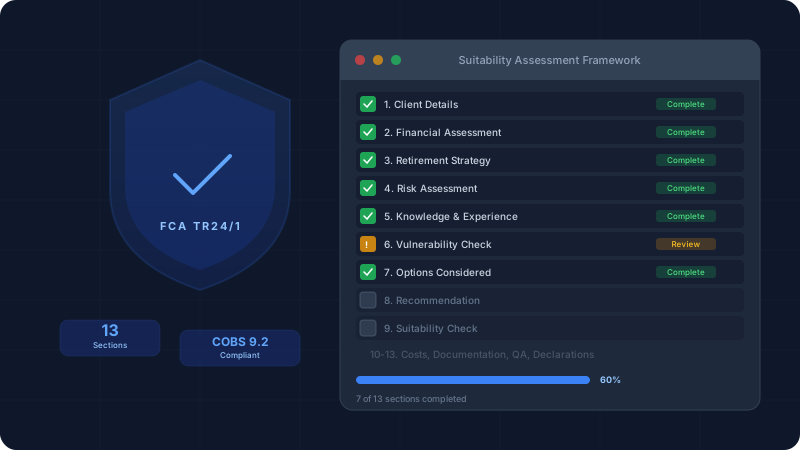
TR24/1
Structured guidance and evidence-ready outputs.
What FCA TR24/1 means for your suitability process
A detailed analysis of the FCA's thematic review on suitability assessments, what it requires from firms, and how to build a process that meets the standard.
By Plannetic Research
Highlights
Thematic review
TR24/1
FCA thematic review of suitability practices across firms.
Assessment sections
13
Sections required for comprehensive suitability coverage.

Evidence standard
100%
Firms reviewed must evidence compliance across all areas.
The regulatory context
TR24/1 represents the FCA's focused examination of how firms conduct suitability assessments. The thematic review was prompted by persistent concerns that too many firms treat suitability as a point-of-sale compliance exercise rather than a substantive process for demonstrating that advice is appropriate for each client.
The FCA's findings make clear that the regulator is not satisfied with the status quo. Across the firms reviewed, common weaknesses included incomplete client profiling, superficial risk assessments, and a lack of documented reasoning linking client circumstances to recommendations. These are not new concerns — the FCA has raised them repeatedly — but TR24/1 signals an escalation in supervisory expectations.
For firms operating under COBS 9.2, the message is direct: the regulator expects a structured, evidenced approach to suitability that goes beyond ticking boxes on a questionnaire. The review applies to all firms providing personal recommendations on retail investment products, pensions, and structured deposits.
Key requirements for suitability assessments
TR24/1 reinforces the core requirements of COBS 9.2 while raising the standard of evidence firms must produce. At minimum, a suitability assessment must capture the client's financial situation in sufficient detail to support the recommendation. This means comprehensive income and expenditure data, asset and liability positions, and a clear understanding of the client's capacity for loss — not just their attitude to risk.
The review is explicit that firms must document the client's knowledge and experience with the product types being recommended. A client who has never held equities requires a different evidential standard than one with decades of investment experience. The assessment must also record any vulnerability indicators and explain how the advice process was adapted in response.
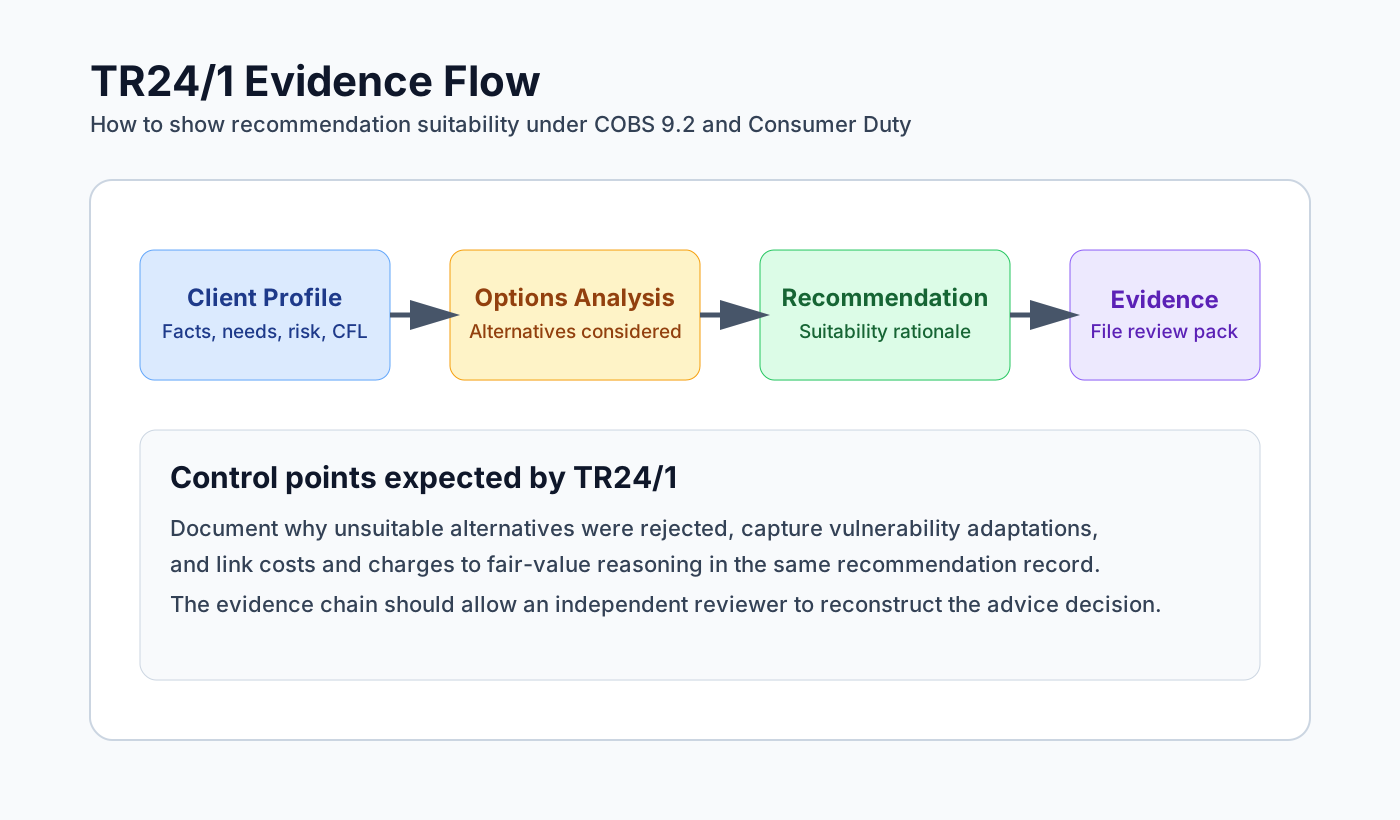
Beyond the client profile, the FCA expects firms to evidence that they have considered a reasonable range of options before arriving at a recommendation. This is not about listing every product in the market — it is about showing that the recommendation was chosen from a considered set of alternatives and that the rationale for selection is defensible.
Where firms commonly fall short
The FCA's findings in TR24/1 identify several recurring deficiencies. Financial assessments frequently lacked depth: firms recorded annual income but failed to capture expenditure patterns, leaving no basis for assessing affordability. Asset positions were recorded without context — the difference between liquid savings and an illiquid property holding is material to suitability, yet many firms treated them identically.
Vulnerability assessments were either absent or perfunctory. Firms acknowledged the requirement but often reduced it to a single yes/no question. The FCA expects a structured assessment that considers health, life events, financial resilience, and capability, with documented adaptations where indicators are present.
Perhaps most critically, many firms failed to document the options they had considered. A suitability report that states the recommendation without explaining why alternatives were rejected is, in the FCA's view, incomplete. The absence of a documented options analysis makes it difficult for firms to demonstrate that the advice was suitable rather than merely convenient.
Building a compliant suitability process
A process that meets TR24/1 expectations requires thirteen distinct assessment sections: client details and objectives, comprehensive financial assessment, retirement strategy, risk assessment encompassing both attitude and capacity, knowledge and experience verification, vulnerability screening, options analysis, recommendation with supporting rationale, explicit suitability confirmation, costs and charges disclosure, documentation checklist, quality assurance, and declarations.
Each section maps to a specific FCA requirement. Client details and objectives address COBS 9.2.2R. The financial assessment and retirement strategy address affordability and capacity for loss. Risk assessment covers both attitude to risk and the client's ability to bear losses — two distinct concepts that many firms conflate. Knowledge and experience verification addresses COBS 9.2.3R.
The recommendation section must contain more than a product name and fund selection. It must articulate why the recommendation is suitable for this specific client given their objectives, risk profile, financial position, and time horizon. Where the recommendation involves trade-offs — such as accepting higher charges for a particular wrapper — the rationale for that trade-off must be documented.
Consumer Duty alignment
TR24/1 does not exist in isolation from the Consumer Duty (PS22/9). The four Consumer Duty outcomes — products and services, price and value, consumer understanding, and consumer support — map directly onto the suitability assessment process. A comprehensive suitability assessment is, in effect, the primary mechanism through which firms evidence Consumer Duty compliance for personal recommendations.
The understanding outcome requires evidence that the client comprehends the recommendation. The fair value outcome requires that costs are proportionate and disclosed. The suitable products outcome requires a documented chain of reasoning from client profile to product selection. The support outcome requires ongoing care infrastructure, beginning with vulnerability assessment.
Firms that treat suitability and Consumer Duty as separate compliance workstreams are duplicating effort. A well-structured suitability process should satisfy both sets of requirements simultaneously.
Putting it into practice
The gap between understanding what TR24/1 requires and implementing it consistently across a firm is significant. Manual processes introduce variability — different advisers capture different levels of detail, and the quality of documentation varies with workload and time pressure.
You can test a comprehensive 13-section suitability assessment framework aligned to TR24/1 requirements using our free suitability assessment tool at plannetic.com/suitability. The tool covers all sections discussed in this article, with auto-calculated results, risk flag identification, and Consumer Duty alignment checks. No account is required.