Risk Profiling
Structured guidance and evidence-ready outputs.
Decumulation risk profiling: why your ATR questionnaire isn't enough
TR24/1 found risk profiling was designed for accumulation, not retirement income. ATR and CFL were conflated. How to fix it.
By Plannetic Research
Highlights
Accumulation bias
All 24
No firm had decumulation-specific risk profiling language.
CFL incomplete
9 of 67
Files with incomplete capacity for loss assessment.
K&E missing
6 of 67
Files where knowledge and experience was not established.
The accumulation bias
The FCA reviewed risk profiling processes at all 24 firms in the TR24/1 sample and found that none showed a clear distinction between accumulation and decumulation approaches (paragraph 2.23). Questionnaires were framed in the language of growth investing: time horizons of 10 or more years, willingness to accept short-term volatility for long-term gain, and comfort with capital fluctuation. These are reasonable questions for a 40-year-old building a pension. They are the wrong questions for a 67-year-old who needs to draw income from that pension for the next 30 years.
Decumulation has fundamentally different risk dynamics. Sequence-of-returns risk means that a market downturn in the early years of drawdown has a disproportionate impact on the sustainability of the fund — an effect that does not apply during accumulation. Income sustainability requires modelling not just whether the fund grows, but whether it can support regular withdrawals without exhaustion. Longevity risk means the client may live 20 or 30 years in drawdown, during which inflation steadily erodes purchasing power. None of these risks are captured by standard accumulation-focused questionnaires.
The practical consequence is that risk profiles assigned during accumulation may be inappropriate for the same client in decumulation. A client assessed as "balanced" during their working life may need a more conservative approach once they are drawing income, simply because the nature of the risk has changed. The FCA's finding that all 24 firms had this blind spot suggests the problem is industry-wide, rooted in the design of the tools rather than the behaviour of individual advisers.
ATR vs CFL: why they must be separate
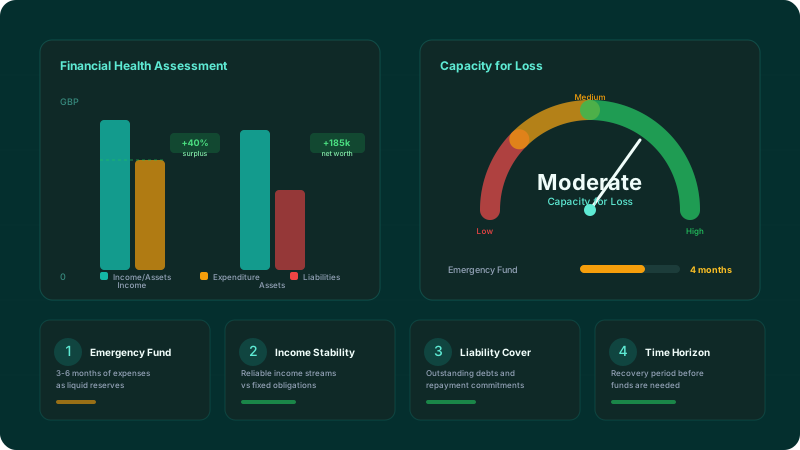
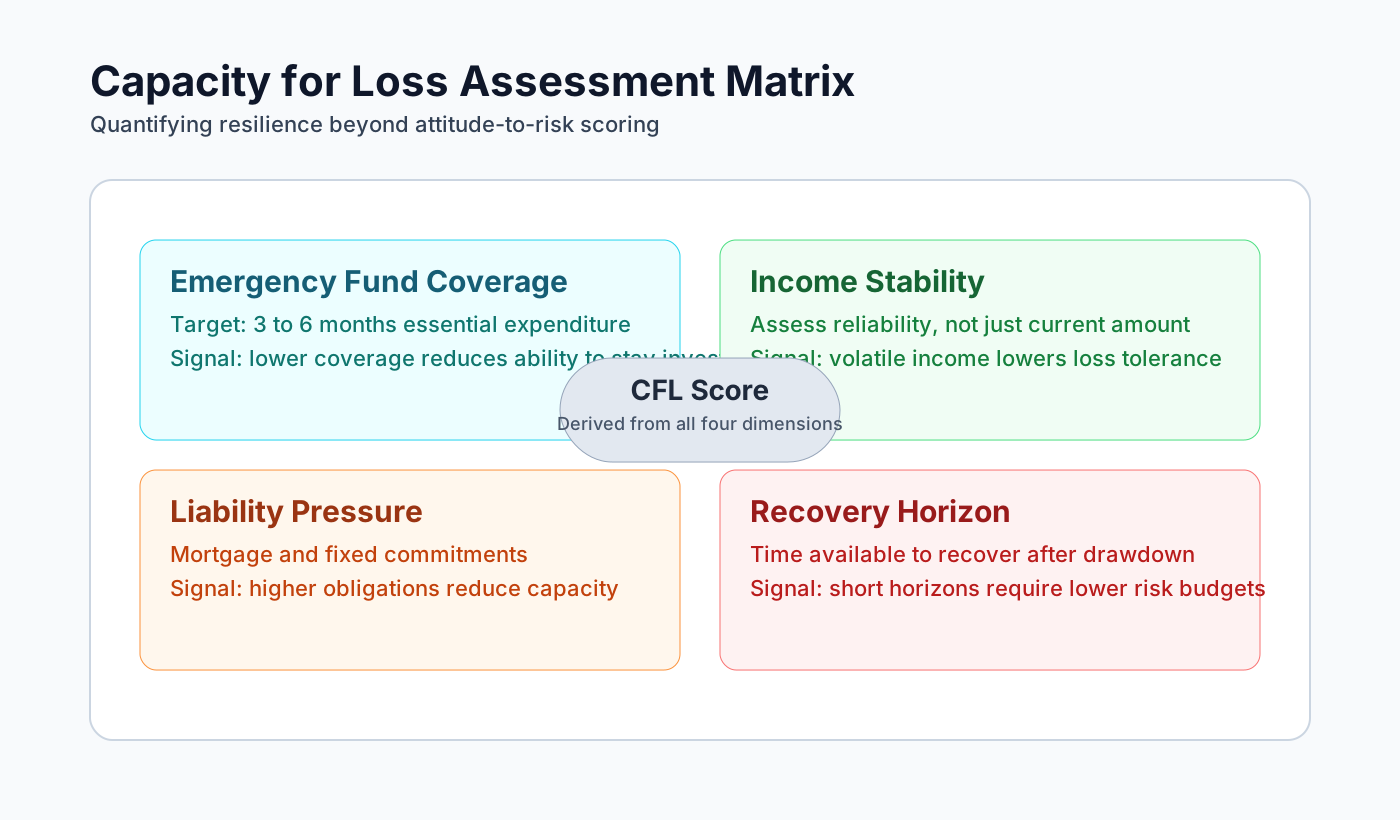
FG11/05 requires firms to assess attitude to risk and capacity for loss separately. Attitude to risk is a psychological measure — the client's willingness to accept uncertainty in pursuit of returns. Capacity for loss is a financial measure — the client's ability to absorb a loss without material impact on their standard of living. These are different things, and they can point in different directions. A retired executive may be psychologically comfortable with investment risk (high ATR) but financially dependent on the pension for essential income (low CFL).
TR24/1 found that most firms had combined these assessments, with some using a single questionnaire that produced a single output (2.24). This conflation is dangerous because it masks the constraint that should govern the investment recommendation. The FCA praised firms that used separate processes — distinct questionnaires or tools for ATR and CFL, producing separate scores that were then considered together in the recommendation.
The regulatory expectation is clear: a client's investment solution should reflect the more conservative of their ATR and CFL. If a client scores "balanced" on ATR but their CFL assessment shows they cannot afford to lose more than 10% of their fund without falling below their essential income need, the portfolio must reflect the CFL constraint. Combining ATR and CFL into a single score obscures this analysis and produces recommendations that may be suitable on paper but indefensible under scrutiny.
Decumulation-specific profiling
Building a risk profiling process that works for decumulation requires asking different questions. Instead of "how would you feel if your investments fell by 20%?", the relevant question is "how would you feel if your monthly income had to be reduced by 20% for two years?". The first question measures tolerance for capital volatility. The second measures tolerance for income volatility — which is what actually matters when the client is drawing from the fund.
Decumulation-specific profiling should address: the split between essential and discretionary income needs, the timeline over which income is required, the timing and amount of state pension entitlement, other income sources and their reliability, health factors that affect longevity assumptions, the client's requirement for income flexibility versus stability, and their attitude specifically to income reduction as distinct from capital fluctuation. The FCA highlighted good practice from firms that supplemented standard questionnaires with retirement-focused discussion covering these areas (2.23).
Knowledge and experience is the third leg of the assessment. TR24/1 found that 6 of 67 assessed files did not establish the client's knowledge and experience (3.17). This is a COBS 9.2 requirement, not an optional extra. For decumulation clients, knowledge and experience is particularly important because the products are complex — drawdown involves ongoing investment decisions, tax management, and income sustainability analysis that many clients have not previously encountered.
The lower-of calculation
Once ATR and CFL are assessed separately, the investment recommendation should align to the lower of the two scores. This is not explicitly stated in the FCA rules, but it follows logically from the suitability requirements in COBS 9.2 and the guidance in FG11/05. If a client's ATR is "balanced" (score 5 out of 7) but their CFL is "cautious" (score 3 out of 7), a balanced portfolio exposes the client to losses they cannot afford. The suitable recommendation is cautious.
Consider a practical example. A client has a pension fund of £400,000, needs £20,000 per year in income, and has state pension of £11,500 starting in three years. Their ATR questionnaire places them in the "balanced" category. But their CFL analysis shows that a 20% market fall in year one would reduce the fund to £320,000, and at £20,000 per year withdrawal the fund would be exhausted before the client reaches 85. The CFL constraint clearly overrides the ATR preference.
The lower-of calculation should be documented in the suitability report with clear reasoning. "Mr Smith's attitude to risk was assessed as balanced (score 5/7). However, his capacity for loss was assessed as cautious (score 3/7) because his essential income need of £20,000 per year represents a high proportion of sustainable income from the fund. The recommended portfolio aligns to the lower score of 3/7." This creates an audit trail that demonstrates the adviser considered both factors and applied the appropriate constraint.
Building this into your process
Practical implementation starts with reviewing your current questionnaire for accumulation language. Read every question and ask: does this make sense for someone entering drawdown? Replace references to long-term growth with references to income sustainability. Replace questions about comfort with capital fluctuation with questions about comfort with income reduction. Add questions on essential versus discretionary income, state pension timing, health factors, and other income sources.
Implement separate scoring for ATR and CFL. If you use a third-party risk profiling tool, check whether it supports separate outputs. If it produces a single blended score, you need to supplement it with a separate CFL assessment. The CFL assessment should be quantitative: what is the client's essential income need, what fund value is required to sustain it, and what percentage loss would breach that threshold? Auto-calculate the lower-of score and flag any cases where the ATR and CFL scores diverge by more than one band.
Document the rationale for every risk profile decision. Where ATR and CFL align, this can be brief. Where they diverge, the documentation must explain why the lower score was applied and how the recommended portfolio reflects the CFL constraint. This documentation is your defence if the file is reviewed — whether by your own QA, by a compliance consultant, or by the FCA. A well-documented risk profile decision is difficult to challenge. An undocumented one is impossible to defend.