Consumer Duty
Structured guidance and evidence-ready outputs.
Consumer Duty and suitability: mapping the four outcomes
How the four Consumer Duty outcomes map to specific sections of a suitability assessment, and why firms should integrate rather than duplicate.
By Plannetic Research
Highlights
Duty outcomes
4
Consumer Duty outcomes to evidence in suitability.
Implementation
PS22/9
The implementation standard for Consumer Duty.
Evidence standard
100%
Suitability reports must evidence all four outcomes.
Consumer Duty as a Suitability Operating Layer
The Consumer Duty, implemented through PS22/9, did not replace the existing suitability framework under COBS 9.2. It layered additional expectations on top of it. Firms must now demonstrate compliance with both the traditional suitability rules and the four Consumer Duty outcomes for every personal recommendation they make. This is an operating model requirement, not a disclosure-only change.
This dual framework creates a challenge for firms. Some have responded by creating separate Consumer Duty compliance processes that run alongside their existing suitability assessments. This approach is inefficient and, more importantly, risks creating inconsistencies between the two streams of evidence. A more effective approach is to integrate Consumer Duty requirements directly into the suitability assessment process.
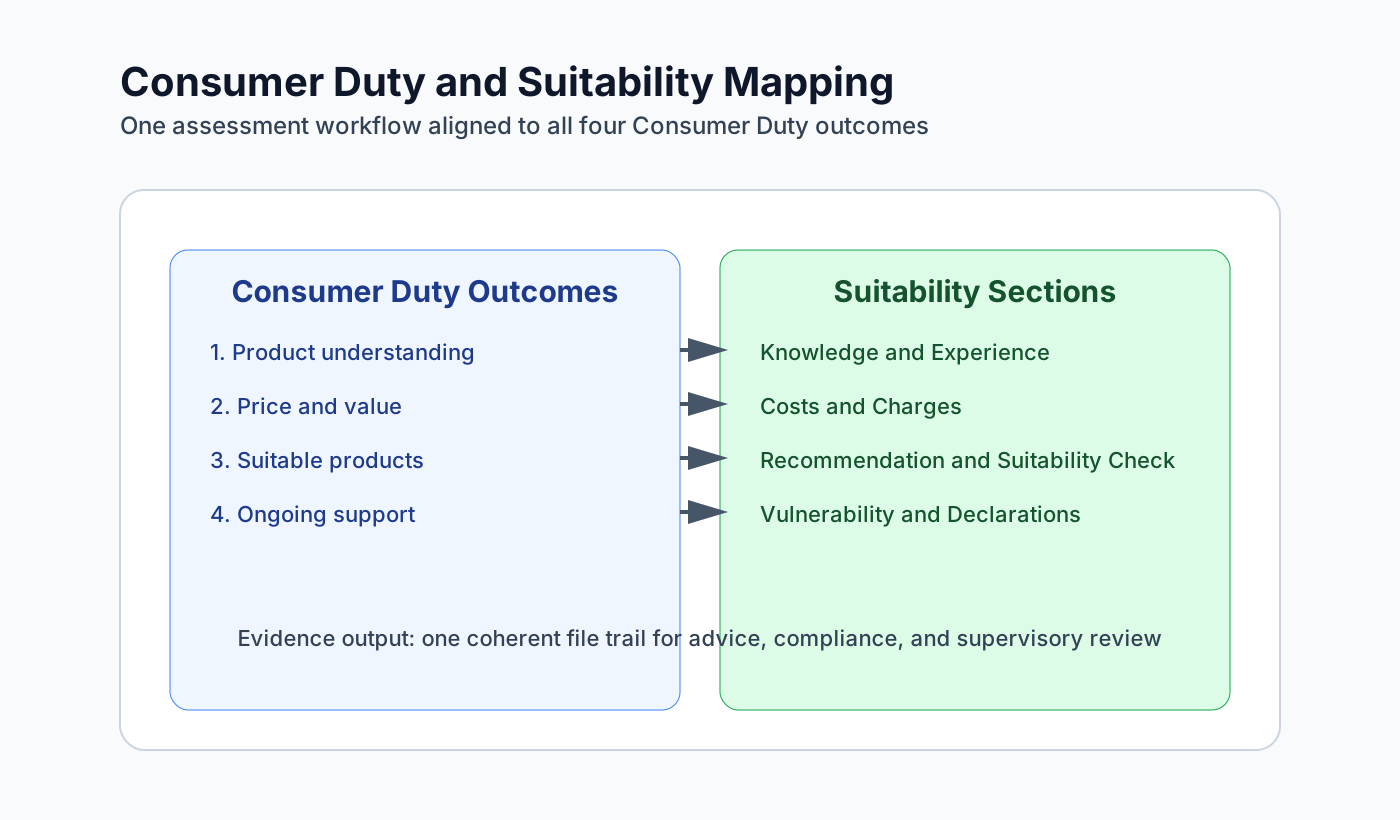
The four outcomes — products and services (understanding), price and value (fair value), consumer understanding (suitable products), and consumer support (ongoing care) — each map to specific sections of a comprehensive suitability assessment. When these mappings are made explicit, a single assessment can satisfy both sets of regulatory requirements.
Outcome 1: Product Understanding and Client Comprehension
The first Consumer Duty outcome requires firms to evidence that the client understands the products and services being recommended. This is not a passive requirement. The FCA does not consider it sufficient to provide documentation and assume understanding. Firms must take reasonable steps to assess whether the client actually comprehends what is being proposed.
In a suitability assessment, this maps directly to the Knowledge and Experience section. The assessment should capture the client's existing understanding of the product types being recommended, their experience with similar products, and any gaps in understanding that were identified and addressed during the advice process.
The evidence standard is higher than many firms currently meet. Recording that a client has "basic" investment knowledge is a starting point, but the assessment should also document what steps the adviser took to explain the recommendation in terms the client could understand. Where a product involves complex features — such as a structured product with conditional capital protection — the evidence of understanding must be proportionately more detailed.
Outcome 2: Price and Value Evidence
The second outcome requires that the price the client pays is proportionate to the value they receive. In suitability terms, this maps to the Costs and Charges section. However, the Consumer Duty expectation goes beyond simple disclosure of fees. Firms must demonstrate that the total cost of the recommendation — including initial charges, ongoing charges, platform costs, and any other fees — represents fair value relative to the service provided.
This requires a documented justification, not just a schedule of charges. A suitability assessment that states "ongoing charges of 1.5% per annum" without explaining why that level of charge is proportionate to the service does not meet the fair value test. The assessment should explain what the client receives for the fee: the level of ongoing advice, the scope of the review service, and the value of the platform or investment solution selected.
The FCA has indicated that it expects firms to conduct fair value assessments at product level. For suitability assessments, this means the costs section should include a brief analysis of whether the total ongoing charges are competitive for the type of service and product being recommended.
Outcome 3: Consumer Understanding and Suitable Products
The third outcome focuses on ensuring that products are suitable for the consumer's needs. This is the most direct overlap with the traditional suitability framework. The Recommendation and Suitability Assessment sections of the assessment must show a clear, documented chain of reasoning from the client's objectives, risk profile, and financial position through to the specific product recommendation.
The FCA expects more than a statement of suitability. It expects a documented reasoning process: why this product, for this client, at this time. The assessment must address potential objections: if a cheaper alternative exists, why was it not recommended? If the product carries specific risks, why are those risks acceptable given the client's capacity for loss?
The suitability check should include explicit confirmation that the recommendation meets the client's stated objectives, is appropriate for their risk profile, and is affordable given their financial position. Where any of these conditions is not fully met, the assessment must document the conditions or caveats that apply.
Outcome 4: Ongoing Support and Care Evidence
The fourth outcome requires firms to provide appropriate ongoing support. In suitability terms, this begins with the Vulnerability Assessment section. Identifying vulnerability indicators at the point of advice is the starting point for a support framework. The assessment should document not only the indicators identified but the adaptations made to the advice process and any ongoing support arrangements put in place.
The Declarations section should capture the client's understanding of the ongoing service proposition: what reviews they will receive, how frequently, and what the review process will cover. This is not a contractual matter for the suitability assessment — it is an evidence matter. The FCA expects to see that the client understands the ongoing commitment and that the firm has a mechanism for delivering it.
Consumer support also extends to how the firm handles changes in client circumstances. The assessment should establish a baseline that makes future reviews meaningful. If the assessment captures comprehensive financial data, vulnerability indicators, and capacity for loss at the point of initial advice, subsequent reviews can identify and evidence changes that may affect the ongoing suitability of the recommendation.
Integrated Operating Framework for Advice Teams
Each of the four Consumer Duty outcomes maps to specific sections of a comprehensive suitability assessment. Understanding maps to Knowledge and Experience. Fair Value maps to Costs and Charges. Suitable Products maps to Recommendation and Suitability Check. Consumer Support maps to Vulnerability Assessment and Declarations.
When these mappings are built into the assessment structure, a single process can satisfy both COBS 9.2 and Consumer Duty requirements without duplication. The result is a more efficient compliance process that produces a single, coherent evidence trail rather than two parallel and potentially inconsistent ones. The practical benefit is fewer control gaps at file review and better recommendation consistency.
You can see how these four outcomes fit together using our free 13-section suitability assessment tool at plannetic.com/suitability. The tool includes Consumer Duty alignment checks in the results, showing how each outcome maps to the data captured in the assessment sections. No account required.