CFL Guide
Structured guidance and evidence-ready outputs.
Capacity for loss: the assessment most IFAs get wrong
Why attitude to risk is only half the picture. A structured approach to assessing capacity for loss that meets FCA expectations.
By Plannetic Editorial
Highlights
Inadequate records
62%
Firms with inadequate CFL records in FCA samples.
Emergency fund
3-6
Months of expenditure as minimum emergency fund.
CFL dimensions
4
Key dimensions to assess for capacity for loss.
Capacity for Loss: More Than Attitude to Risk
The distinction between attitude to risk and capacity for loss is fundamental, yet a significant proportion of firms continue to conflate the two. Attitude to risk measures a client's psychological willingness to accept volatility and potential losses. Capacity for loss measures their financial ability to absorb those losses without a material impact on their standard of living.
A client may express a high willingness to accept risk — they may genuinely believe they would be comfortable with a 30% portfolio drawdown — but if their financial position means that a 30% loss would force them to sell their home or delay retirement by a decade, their capacity for loss is demonstrably lower than their stated attitude suggests.
The FCA has been explicit on this point. FG11/05 states that firms must assess capacity for loss as a separate exercise from attitude to risk. COBS 9.2.2R requires that the firm obtain sufficient information about the client's financial situation to ensure the suitability of the recommendation. A risk questionnaire alone does not satisfy this requirement.
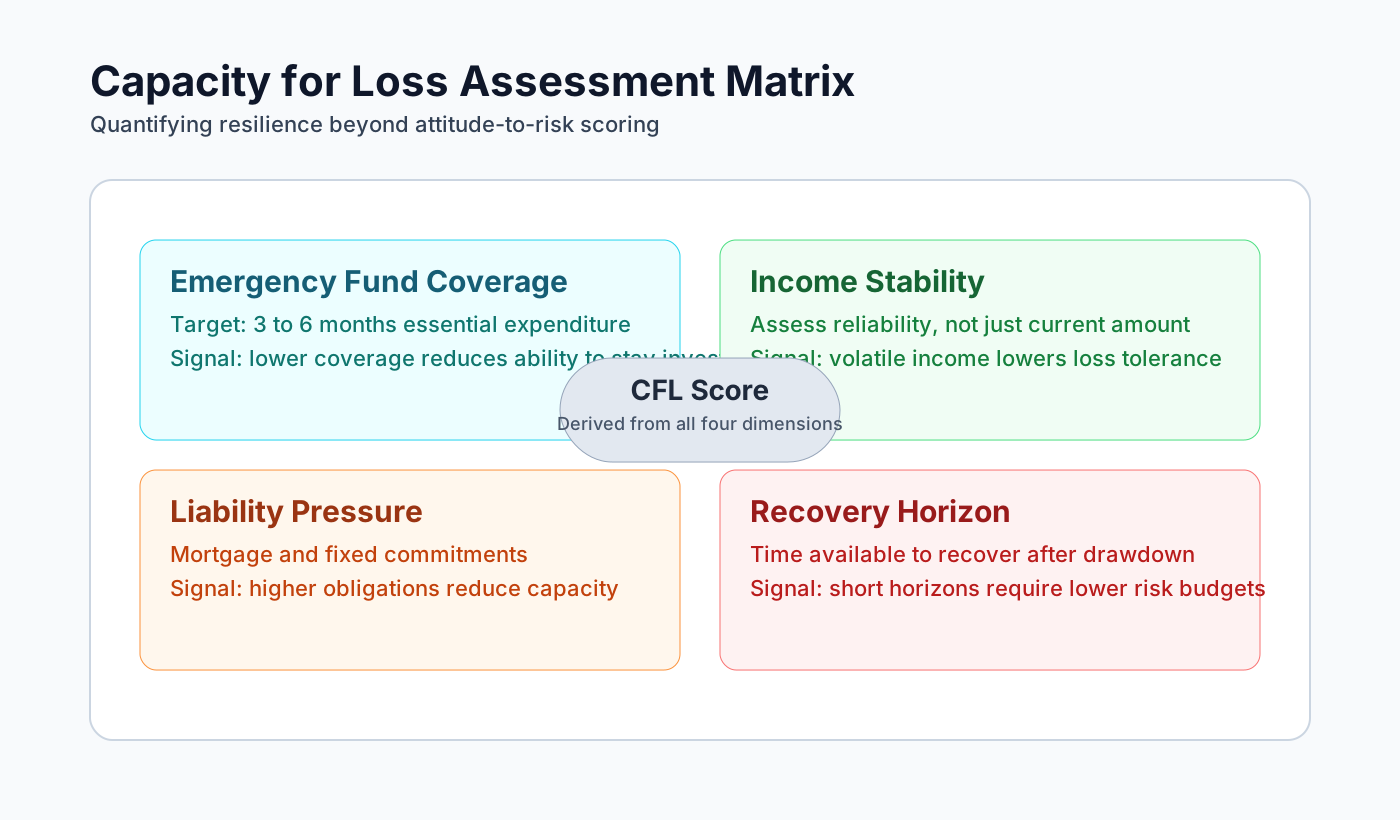
The four dimensions of capacity for loss
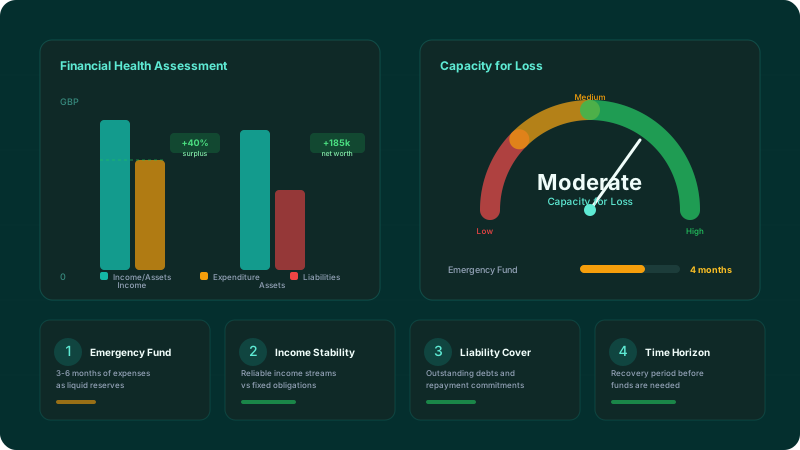
A structured CFL assessment should evaluate four dimensions. The first is emergency fund adequacy: how many months of essential expenditure can the client cover from liquid savings without touching their invested assets? The FCA has not prescribed a specific threshold, but industry practice and FCA commentary suggest a minimum of three to six months. Clients with inadequate emergency reserves may not have the capacity to remain invested through a downturn.
The second dimension is income stability. An employed client with a stable salary, employer pension contributions, and no dependants has materially different capacity from a self-employed contractor with variable income and three school-age children. The assessment must consider not just current income but its reliability and the consequences of its interruption.
The third dimension is liability obligations. Outstanding mortgage debt, ongoing maintenance obligations, and contractual commitments all constrain the client's capacity to absorb investment losses. A client with no debt and a paid-off property has greater capacity than one with an 80% loan-to-value mortgage, even if their asset positions appear similar on paper.
The fourth dimension is time horizon to recovery. A client investing for a goal twenty years away has the capacity to recover from short-term losses in a way that a client three years from retirement does not. The assessment must quantify this: how long can the client remain invested, and does that timeframe provide sufficient opportunity to recover from the maximum probable drawdown at the chosen risk level?
Common CFL mistakes
The most prevalent error is treating CFL as a subset of the attitude to risk questionnaire. Adding a question about "how would you feel if your investment fell by 20%" to a behavioural risk questionnaire does not constitute a capacity for loss assessment. CFL is a financial analysis, not a psychological one. It requires quantitative data: income figures, expenditure breakdowns, asset liquidity analysis, and liability schedules.
A second common mistake is using qualitative descriptors instead of quantitative analysis. Recording that a client has "moderate" capacity for loss provides no defensible basis for the recommendation. The assessment should state that the client can sustain a drawdown of a specific percentage over a specific period without needing to crystallise losses or alter their financial commitments.
A third error is failing to reassess CFL at review. Capacity for loss is not static. A client who had high capacity at the point of initial advice may have reduced capacity two years later due to a change in employment, a health event, or a shift in family circumstances. Annual reviews should include a CFL update.
A structured approach to CFL assessment
A defensible CFL section should capture five data points at minimum. First, the client's emergency fund expressed as months of essential expenditure coverage. This requires knowing both the fund balance and the monthly expenditure figure — a ratio, not a single number. Second, the maximum acceptable loss percentage — stated as a specific figure, not a qualitative band.
Third, income surplus: the difference between total income and total expenditure on an annual basis. A client with a positive surplus has a buffer; a client spending more than they earn has negative capacity by definition. Fourth, asset liquidity: what proportion of the client's assets can be accessed within 30 days without penalty? Illiquid assets such as property or locked pension funds do not contribute to short-term capacity.
These data points feed directly into the suitability determination. If the emergency fund covers fewer than three months, this is a risk flag. If the maximum acceptable loss is lower than the probable drawdown at the recommended risk level, the recommendation must either reduce the risk level or document why the mismatch is acceptable. If the income surplus is negative, investment may not be appropriate until the deficit is addressed.
Try it yourself
Our free suitability assessment at plannetic.com/suitability includes a dedicated risk assessment section with capacity for loss analysis. The tool calculates emergency fund coverage from the data you provide, captures maximum loss tolerance, and flags mismatches between risk category and stated capacity. It also factors CFL into the overall suitability determination and Consumer Duty alignment checks.
The assessment covers all four CFL dimensions discussed in this article and generates a scored output with specific risk flags where capacity concerns are identified. Complete it in under ten minutes — no account required.