Board Assurance
Structured guidance and evidence-ready outputs.
Board MI for advisory firms: the metrics that actually evidence Consumer Duty
Board packs often look busy but prove very little. The stronger standard is outcome-led MI that links client signals, management decisions and remediation closure.
By Plannetic Research
Highlights
Outcome MI
Board-ready
The board should see client-impact signals, not just process activity counts.
Remediation visibility
Closed-loop
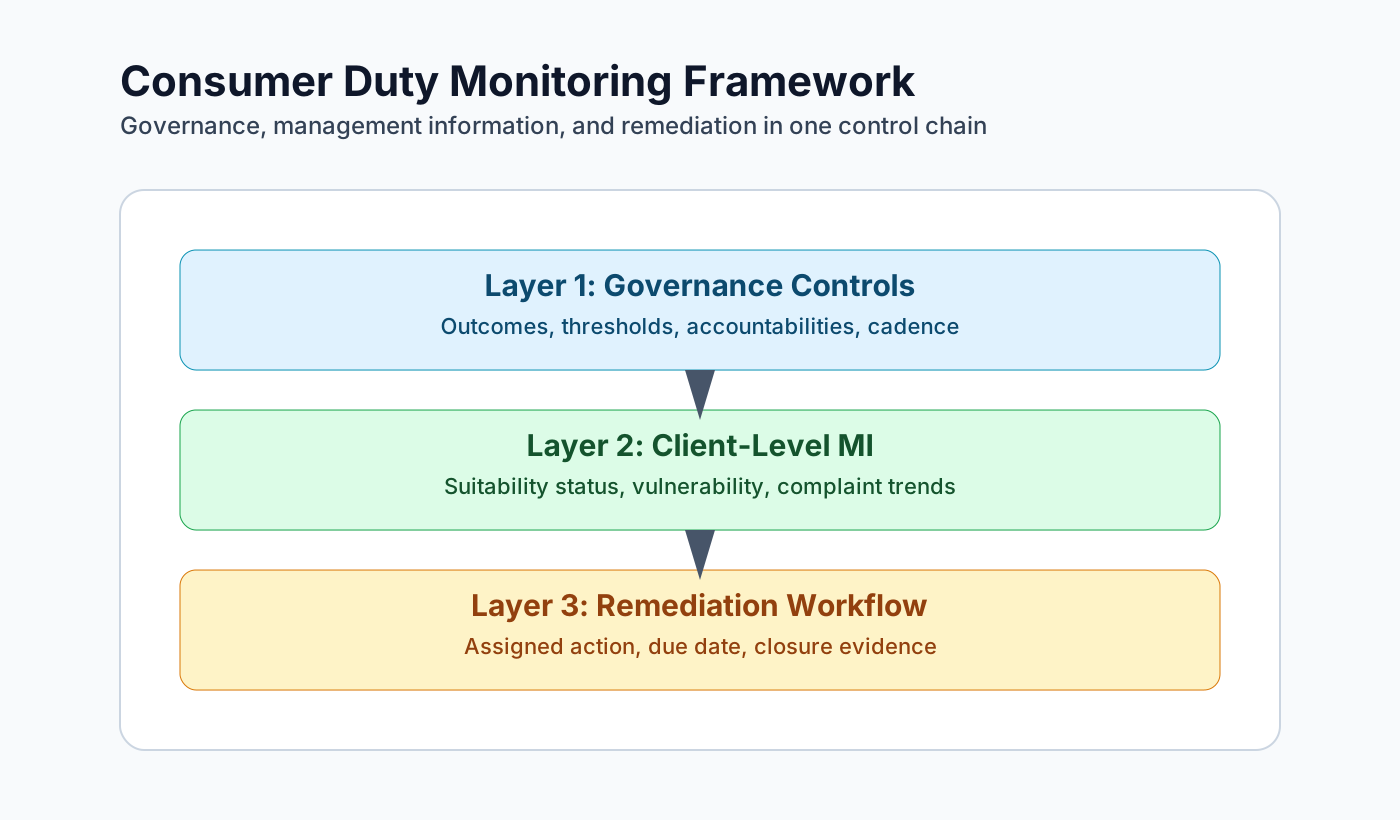
Escalations matter only when the board can see whether they were resolved.
Evidence chain
Traceable
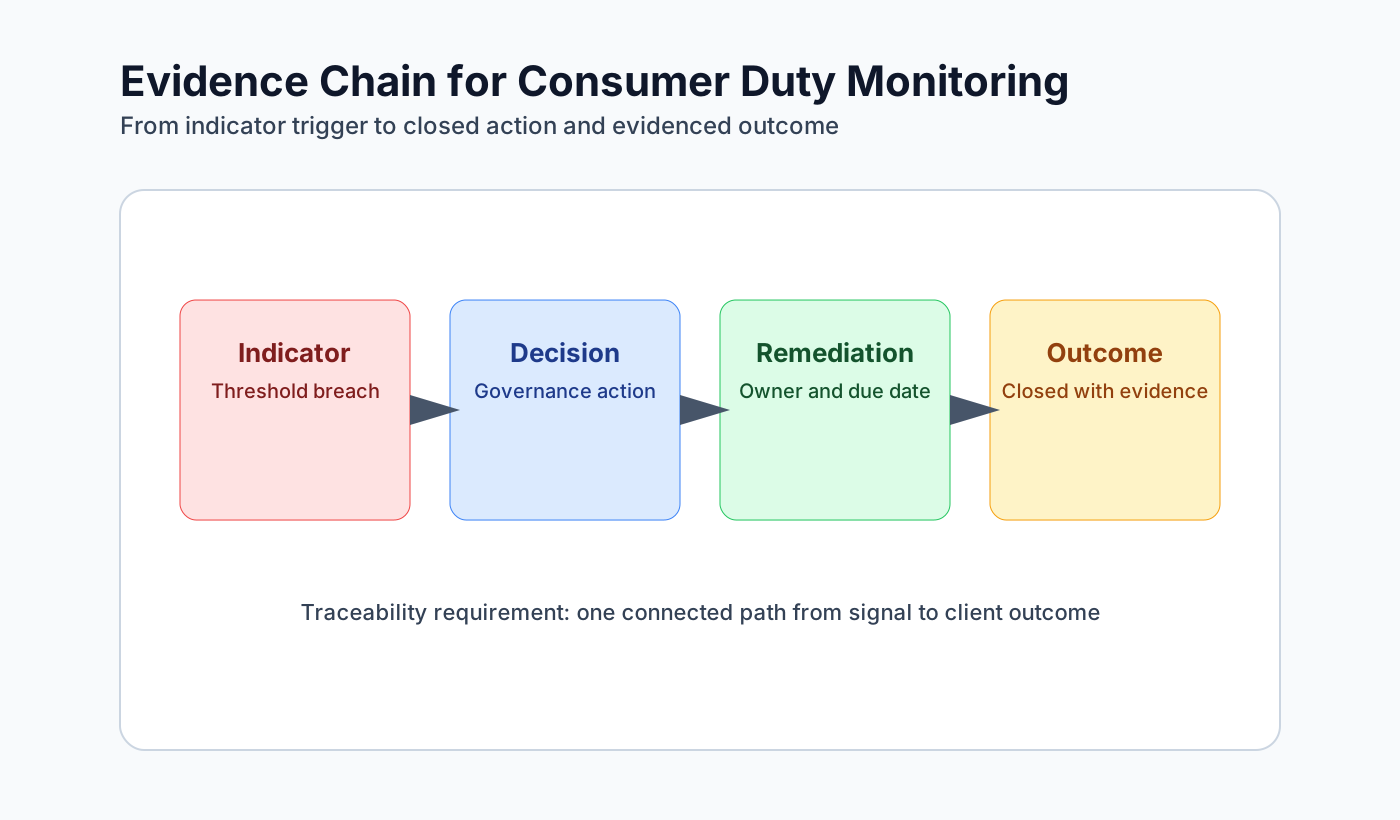
From indicator to committee action to client-level resolution.
Why most board packs are too activity-heavy
Many advisory firm board packs contain impressive volumes of data: number of reviews completed, number of files checked, number of complaints logged, number of vulnerable customers identified. The weakness is not quantity. It is that the measures often tell the board what happened administratively, not whether the firm is producing good outcomes or intervening effectively when outcomes deteriorate.
This distinction matters under Consumer Duty. The FCA does not want firms to collect data for its own sake. It expects firms to monitor whether products and services are working as intended, whether clients receive fair value, whether communications are understood, and whether support is effective when problems arise. A board pack that cannot show movement from signal to management action to remediation outcome is not strong MI, even if it is full of numbers.
The practical problem is that many firms still build MI from disconnected sources: spreadsheets, QA reports, complaint logs, CRM extracts and committee papers. That makes the final board pack descriptive rather than analytical. It is a monthly or quarterly narrative assembled after the event, not a control surface that helps leadership decide where to intervene.
The metrics boards should actually care about
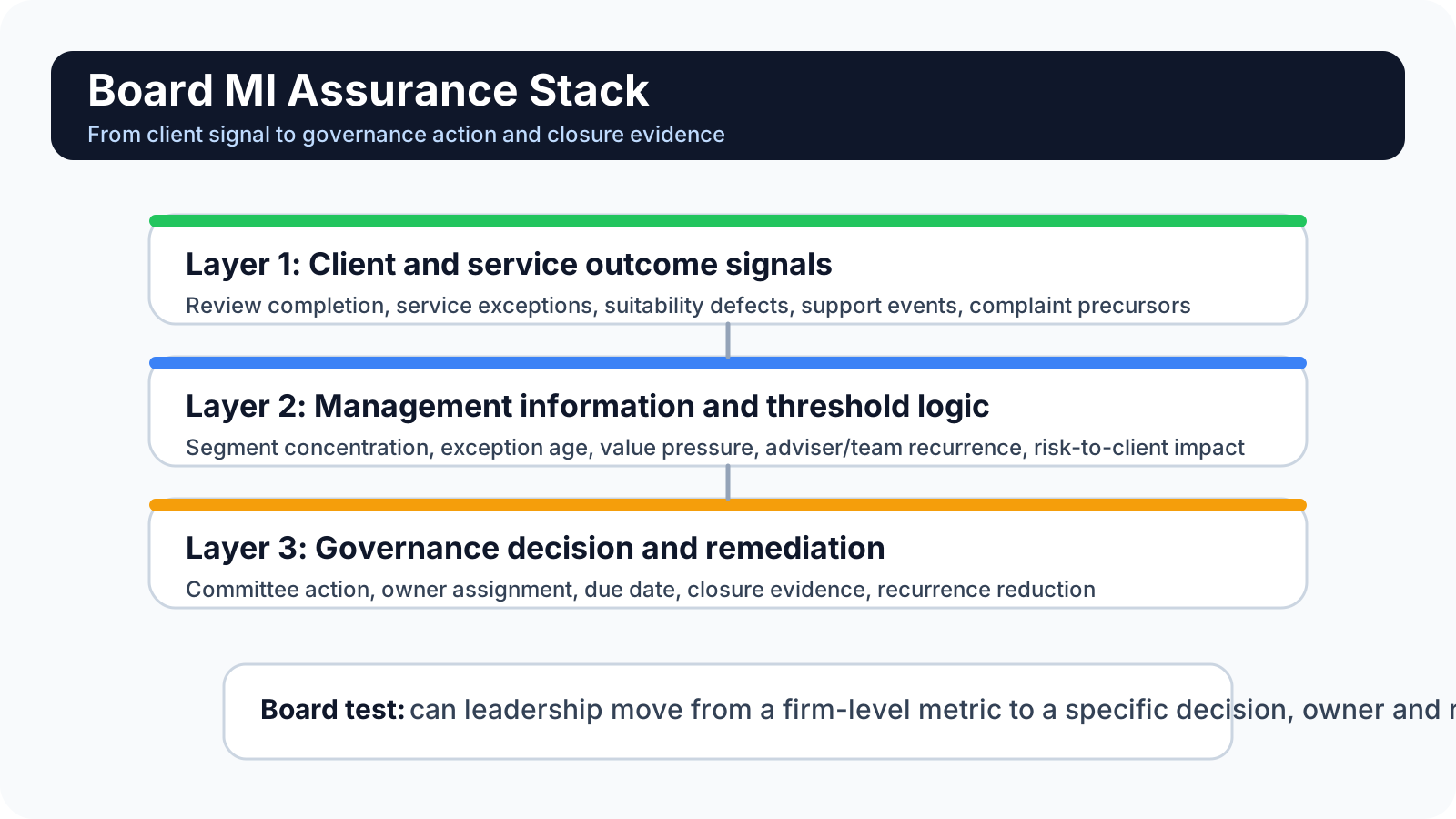
The strongest board packs focus on a small number of measures that explain service integrity, advice integrity and response quality. Service integrity includes review completion versus commitment, overdue remediation, and unresolved service exceptions. Advice integrity includes suitability defect trends, client-segment concentrations, and repeat findings by adviser cohort. Response quality includes support-event response times, complaint prevention signals, and closure rates for escalated issues.
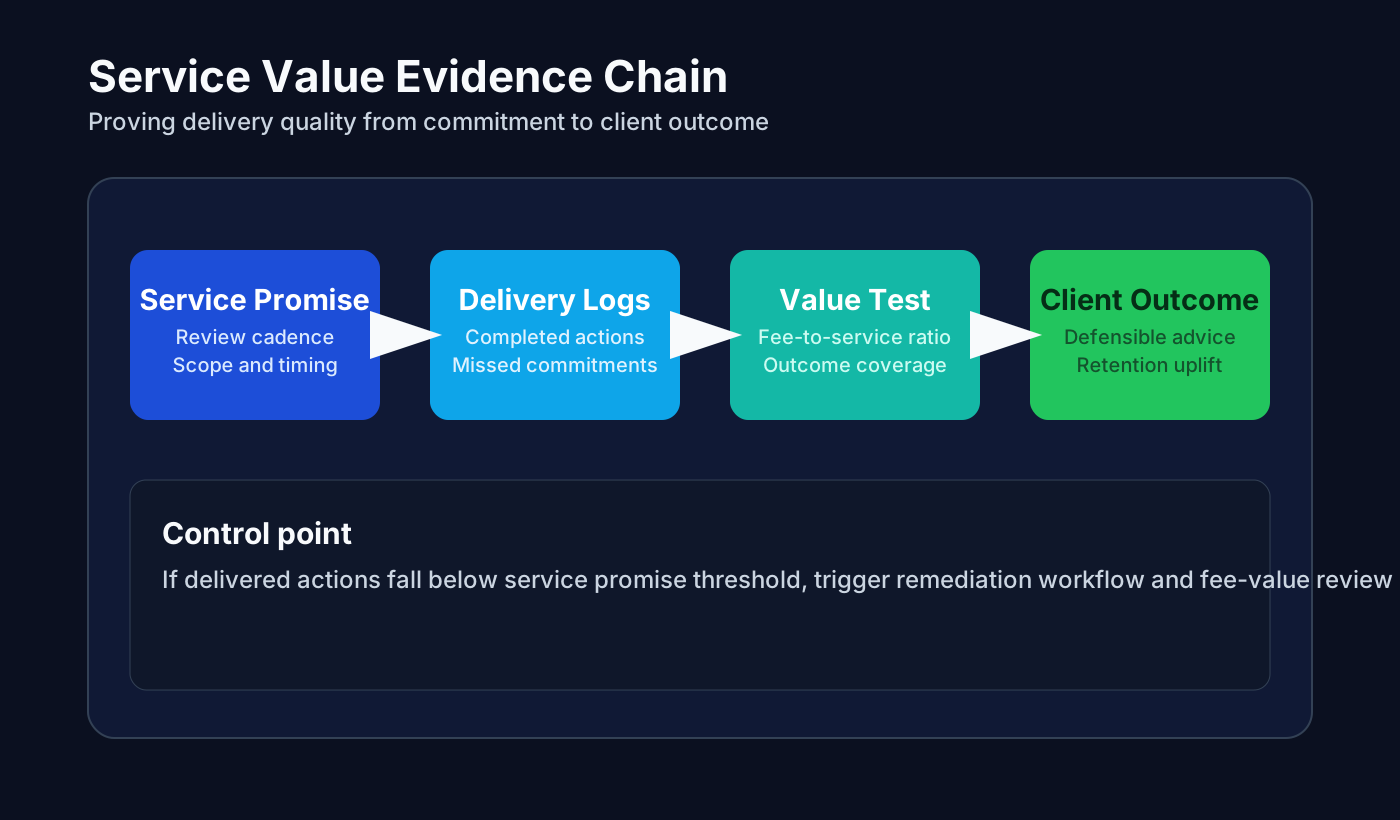
These measures are useful because they can be tied back to the four outcomes. For example, a falling review completion rate and rising remediation age point to consumer support weakness. A segment with high charges and low service completion challenges price and value. A high rate of unclear client communications or post-meeting confusion points toward consumer understanding problems.
The goal is not to create one metric per rule. It is to create a compact dashboard that tells the board where the operating model is slipping and whether management is correcting course quickly enough. That is a higher-quality governance discussion than reviewing activity counts in isolation.
Why remediation closure matters more than escalation volume
Many board packs can show how many issues were escalated. Far fewer can show whether those issues were closed, how long closure took, or whether the same issue type is recurring because the root cause was never addressed. This is where board MI often breaks down. Escalation counts create the appearance of control without proving that the organisation can resolve what it detects.
A better model tracks exception age, owner, client impact and closure standard. It also distinguishes between tactical closure and structural remediation. If a service failure was corrected for one client but the same workflow weakness remains elsewhere, the board should not treat that case as complete. Outcome monitoring without remediation quality is just delayed reporting.
That is why the evidence chain matters. The board should be able to move from firm-level trend to management action to individual case resolution, and then back out again to see whether the fix reduced recurrence. This is the kind of traceability that turns board oversight from passive review into credible governance.
How Plannetic should frame board assurance
Plannetic should position itself as the system that converts fragmented operational evidence into board-usable assurance. The message is not that leadership needs more dashboards. It is that leadership needs a cleaner line of sight between service delivery, advice quality, support events, remediation and client outcome evidence.
That creates value well beyond compliance. A firm with high-quality board MI can detect margin leakage earlier, explain its operating controls more convincingly to buyers or networks, and reduce the gap between supervisory scrutiny and internal management response. For many firms, that is the difference between reporting on the business and actively governing it.