Annual Reviews
Structured guidance and evidence-ready outputs.
Annual review governance: how to prove reviews were delivered, acted on and followed through
Annual reviews are no longer an administrative diary event. Under Consumer Duty they are an evidence problem, a remediation problem, and a board-reporting problem.
By Plannetic Research
Highlights
Review evidence
Traceable
Review scheduling, completion, follow-up and closure should sit in one evidence trail.

Delivery proof
Not diary-led
A booked review is not the same as a completed and evidenced advice event.
Remediation control
Time-bound
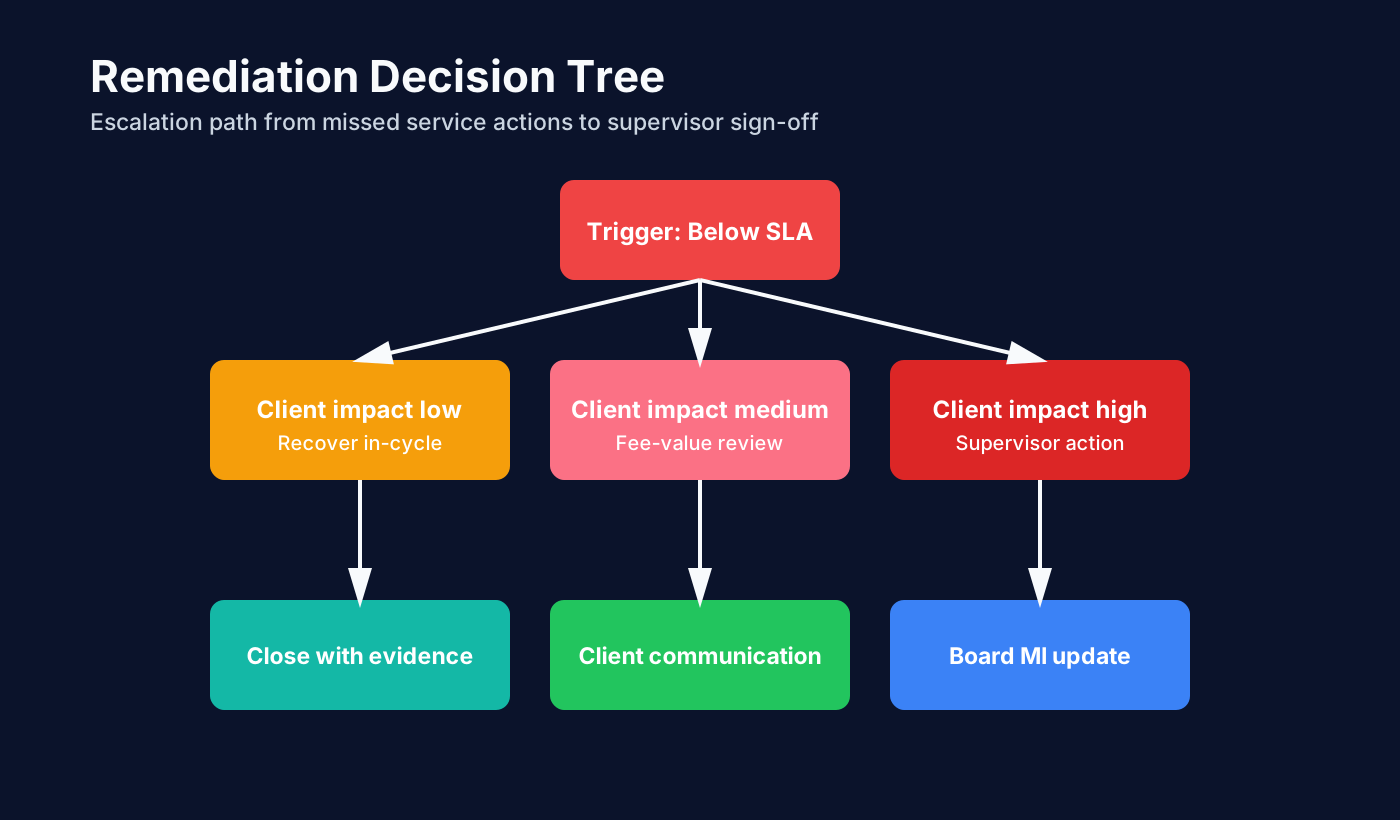
Missed reviews should trigger escalation, ownership and closure evidence rather than apology notes.
Why annual reviews have become a conduct question
Annual reviews used to be described as part of good client service. That language is now too soft. Under Consumer Duty, ongoing service is an evidence-bearing promise. If a firm charges for a review proposition, it must be able to show that the review happened, that it addressed the client's current position, and that any required follow-up was completed rather than merely discussed.
TR24/1 sharpened this point in practical terms. The FCA found 6,108 customers who had paid for ongoing reviews they did not receive. That turns annual review governance from an operational nicety into a live supervisory issue. A firm that cannot distinguish between scheduled reviews, completed reviews and evidenced review outcomes does not have reliable management information on whether clients are receiving the service they are paying for.
This matters particularly in retirement income advice because suitability is not frozen at the point of recommendation. Income needs, expenditure patterns, health, vulnerability, gifting plans, tax position and market conditions all move. A review that simply confirms the diary event took place does not show that the advice remains appropriate. The governance question is therefore twofold: was the review delivered, and did it generate a usable record of the client's updated position and the actions taken in response?
The operational failure behind most missed reviews
Most firms still run reviews through calendar discipline rather than controlled workflow. Reviews are booked in Outlook, captured in CRM notes, summarised in a document, and then only partially reflected in MI. That means leadership teams are often monitoring the wrong thing. They can see whether a meeting was booked, sometimes whether it was held, but not whether the review produced updated data, suitability reasoning, service evidence and a time-bound action list.
This is why review failures persist even in well-intentioned firms. A missed review can hide behind ambiguous statuses such as deferred, rescheduled, partially complete, awaiting information or follow-up required. Unless these states are defined and monitored centrally, the board sees healthy completion rates while clients sit in unresolved states for weeks or months.
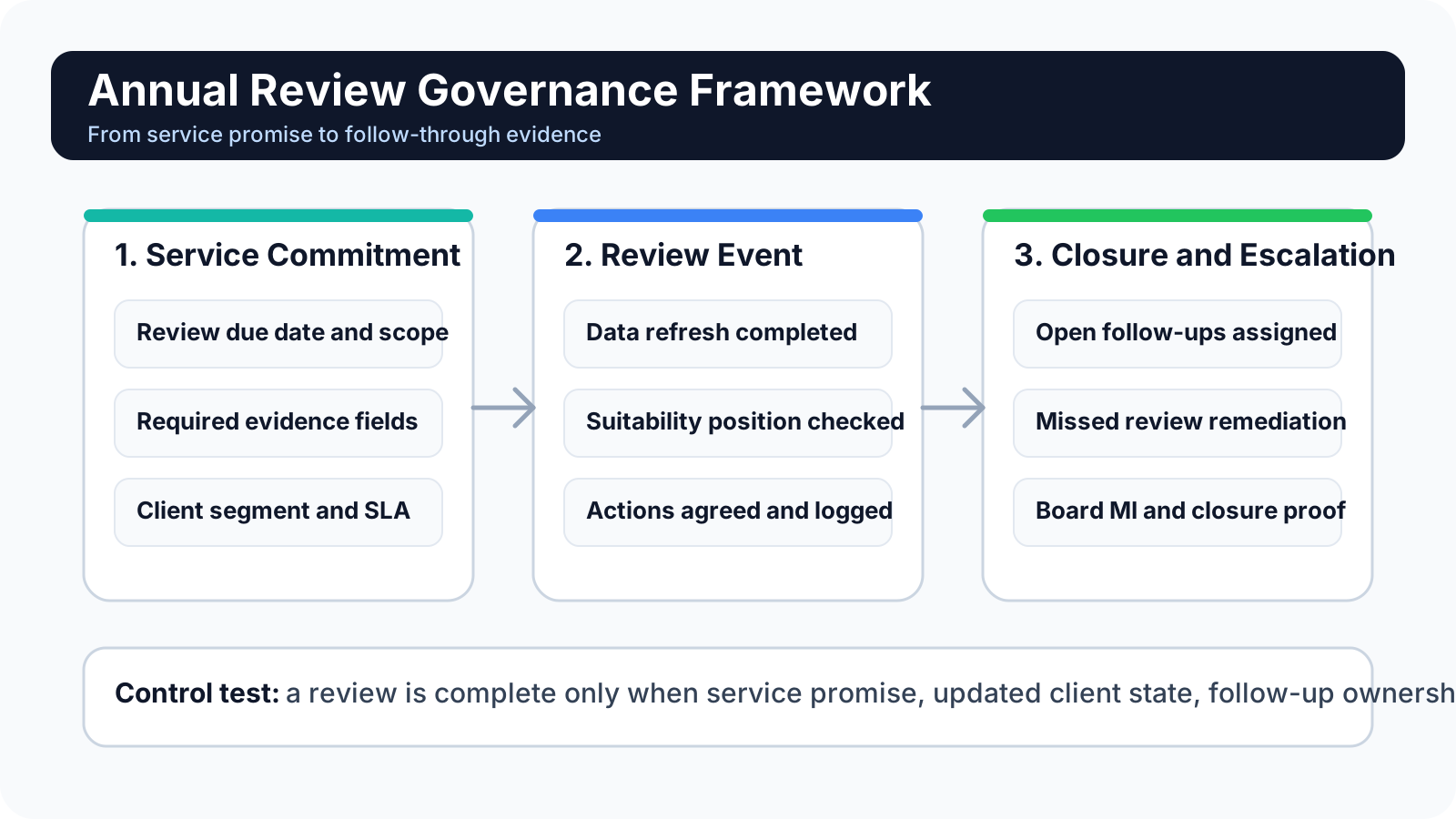
The stronger control model treats review delivery as a workflow with explicit completion rules. A review is not complete until the client state has been refreshed, the advice position has been assessed, the agreed actions have been logged, and any exceptions have an owner and due date. That is the difference between service administration and service governance.
What good review evidence actually looks like
A high-quality review record should show what changed, what remained suitable, what new risks emerged and what the firm agreed to do next. That includes updated income needs, withdrawals, reserves, health or vulnerability indicators, tax considerations, and whether the existing recommendation still aligns with the client's lower-of attitude-to-risk and capacity-for-loss position where relevant.
It should also show service evidence. If the review proposition includes cashflow refresh, tax planning discussion or decumulation stress testing, the record should prove that those elements were delivered or explicitly deferred with a reason. Generic meeting notes do not satisfy this requirement because they rarely map back to the service promise or create a board-usable completion signal.
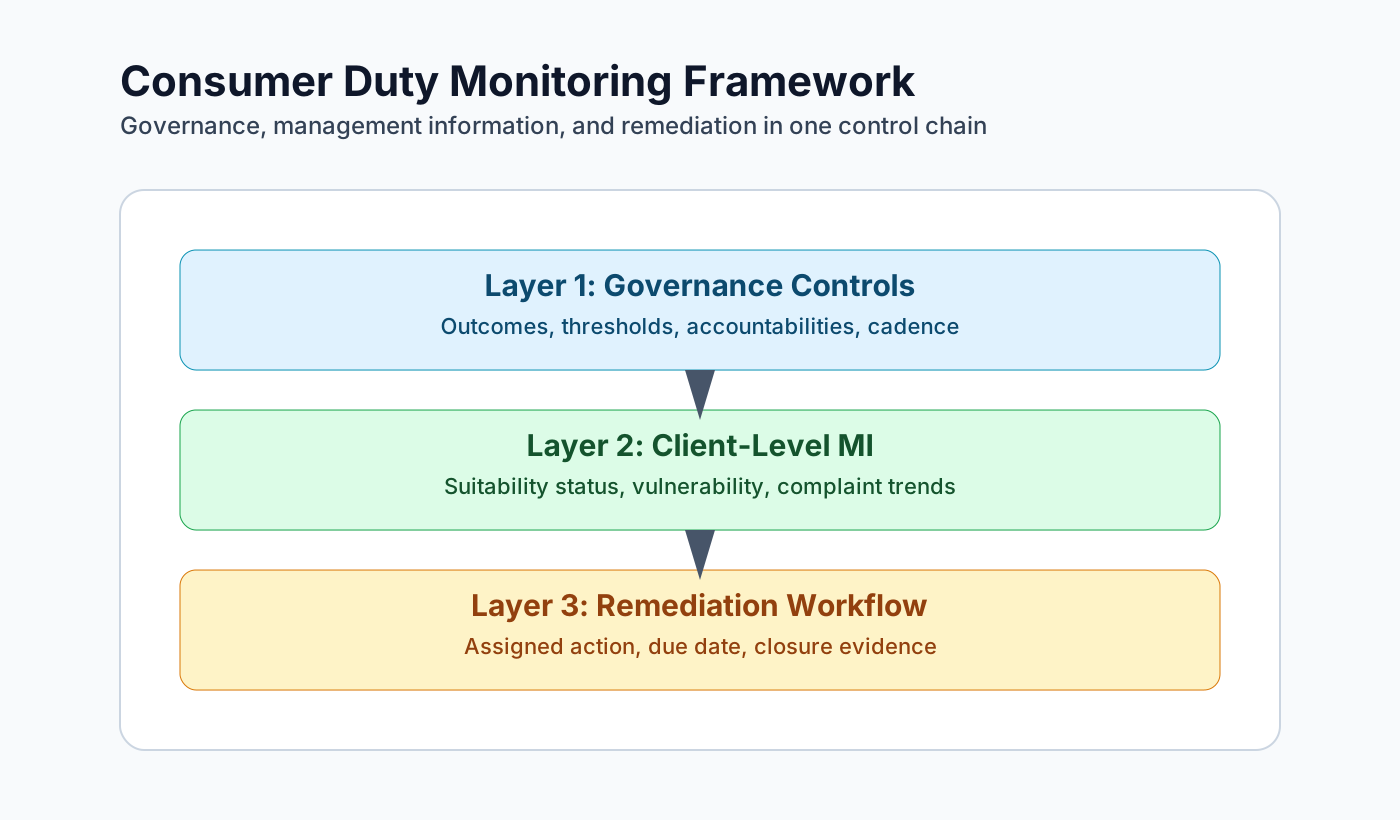
The management information built from that evidence should answer simple but commercially important questions: which clients are overdue, which reviews are in incomplete states, how long remediation is taking, and whether misses are concentrated by adviser, segment or review type. This is the reporting layer that turns annual reviews into a control framework rather than a fee-funded assumption.
How Plannetic should frame the problem
Plannetic's advantage is that it can treat reviews as an evidence-producing workflow rather than a note-taking exercise. The platform can link review scheduling, document refresh, assessment updates, suitability evidence, service-delivery status and remediation tasks in one operating record. That means the board sees not just how many reviews were planned, but which ones genuinely changed the advice state and which ones remain operationally open.
This also gives firms a cleaner Consumer Duty narrative. Instead of defending isolated diary events, they can show a structured chain from service promise to review event to follow-up action to outcome. That is a materially stronger answer when a client, network, consolidator or regulator asks whether ongoing service was actually delivered.
For firms with retirement books, the payoff is even larger. Review quality protects suitability, reduces refund exposure, and gives leadership teams early warning where the service model is failing under load. Annual review governance is therefore not a back-office process. It is a frontline quality and revenue-protection control.