MI & Registers
Structured guidance and evidence-ready outputs.
The advice register problem: why 54% of firms failed FCA scrutiny
TR24/1 found 54% of advice registers had gaps so severe the FCA couldn't trust them. Manual spreadsheets are the root cause. Here's what good MI looks like.
By Plannetic Research
Highlights

Register gaps
54%
Of firms had incomplete or inaccurate advice registers.

QA failure
Widespread
Firms' own QA failed to catch issues the FCA found.
MI requirement
Mandatory
Consumer Duty requires demonstrable outcome monitoring.
What the FCA found
Of the 24 firms the FCA reviewed in depth, 13 — or 54% — had incomplete or inaccurate advice registers (paragraph 2.35). This was not a matter of minor formatting issues or occasional typos. In several cases, the registers were so unreliable that the files the FCA received for review did not match the advice scenarios recorded in the register. The regulator had to request additional data, cross-reference multiple sources, and in some cases ask firms to manually extract information from individual client files because the central records could not be trusted.
The problem was compounded by weak quality assurance. Firms' own QA processes had reviewed many of the same files the FCA subsequently examined — and had signed them off. Yet the FCA found issues that the internal QA had missed (2.36). This is a damning finding: it means the control that firms relied on to catch errors was itself ineffective. When QA checks files but does not identify the same problems the regulator finds, the QA process is not functioning as a genuine control.
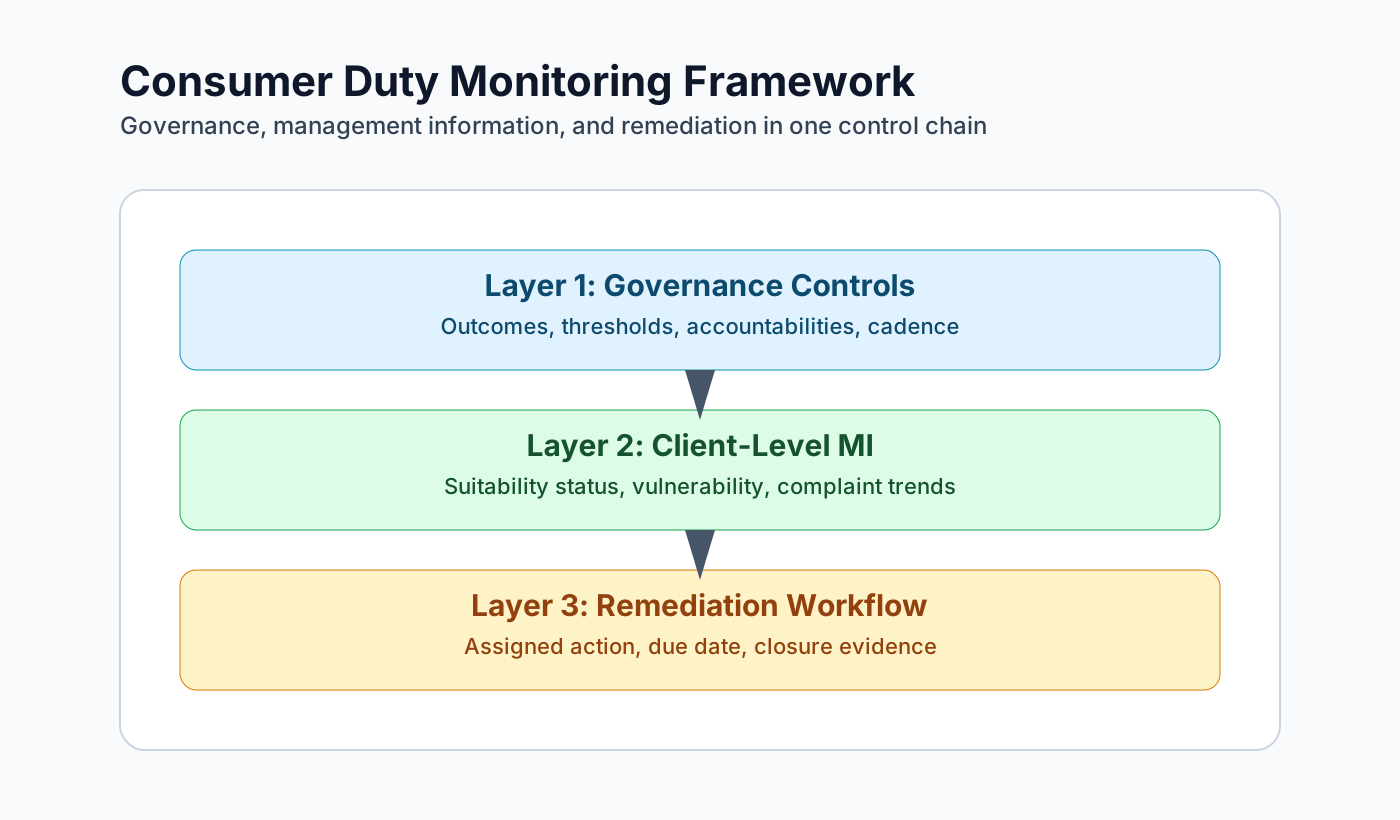
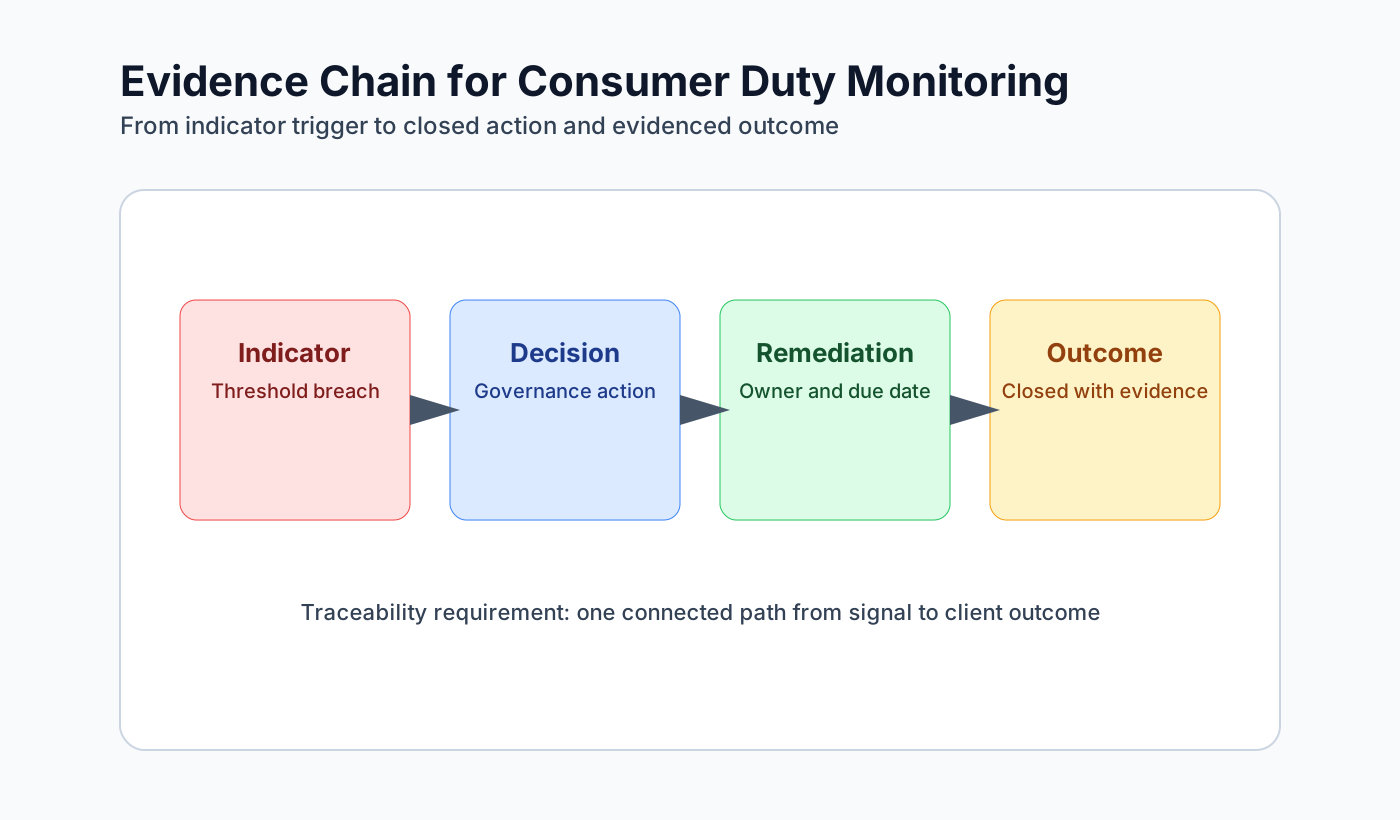
The FCA explicitly linked register accuracy to Consumer Duty compliance. Without reliable management information, firms cannot demonstrate that they are monitoring customer outcomes as the Duty requires (2.37–2.38). A firm that cannot produce accurate data on its own advice activity cannot credibly claim to be meeting its obligations under PRIN 2A. The advice register is not an administrative convenience — it is the evidential foundation of the firm's compliance framework.
Why manual registers fail
The root cause is process design, not individual negligence. Spreadsheet-based advice registers depend on advisers or administrators self-reporting advice data after the event. The information is entered manually, often days or weeks after the advice was given. There is no automatic validation against the actual file contents. If an adviser records a drawdown recommendation when the file shows a mixed strategy, the register silently accepts the error.
This creates a systemic accuracy gap. Data entry that happens after the event, rather than as part of the event, is inherently unreliable. Research on retrospective data entry consistently shows error rates of 10–30% depending on complexity and delay. For advice registers, where the data includes investment strategy, risk profile, charges, and review commitments, even a 10% error rate means one in ten records is wrong. At 54% of firms showing problems, the actual error rate across the industry is likely much higher.
The FCA was explicit that this is inadequate for Consumer Duty monitoring (2.37–2.38). If a firm cannot produce accurate MI on its advice activity, it cannot demonstrate that products are appropriate for the target market, that charges represent fair value, that communications are clear, or that vulnerable customers are identified and supported. Every one of the four Consumer Duty outcomes depends on accurate data, and accurate data depends on process design that prevents errors rather than hoping to catch them.
What good looks like
The FCA highlighted good practice from one firm that had management information clearly showing accountability, third-party oversight, key performance indicators, and data feeding a risk governance board (2.38). The distinguishing feature was not the sophistication of the reporting — it was the fact that the data was generated automatically from the advice process, not retrospectively entered by hand.
In a well-designed system, the advice register is populated as a byproduct of the advice workflow. When an adviser completes a risk assessment, the register records the risk profile. When a suitability report is generated, the register records the recommendation. When a client signs, the register records the acceptance. No separate data entry step is needed because the data already exists in the process.
Centralised measurement is the second critical element. The FCA found that firms were not measuring information centrally (2.34). Data sat in individual files, in different formats, across different systems. Extracting MI required manual collation. By the time the data was assembled, it was often out of date. Good practice means a single source of truth where all advice data is stored, searchable, and reportable without manual intervention.
Automated registers change the economics
When every action in the advice process is logged automatically — fact-find completion, risk assessment, suitability report generation, client approval, review scheduling — the register builds itself. There is no data entry overhead because there is no data entry step. The register is not a separate activity that competes for time with client-facing work; it is an automatic output of the work itself.
This changes the economics of compliance. Manual registers impose a direct cost: time spent entering data, time spent checking data, time spent correcting errors, and time spent producing MI reports. For a firm with 20 advisers writing 600 cases per year, even 15 minutes of register administration per case adds up to 150 hours annually — roughly 4 working weeks. Automated registers eliminate this cost entirely while producing more accurate data.
More importantly, automated registers transform MI from a quarterly reporting burden into a real-time management tool. Instead of assembling data for a board pack, managers can see file quality trends, review completion rates, and outcome metrics as they develop. Problems are visible when they can still be fixed, not three months after the damage is done. This is the difference between compliance as a cost centre and compliance as a management advantage.
Building MI that holds up
Consumer Duty requires firms to monitor customer outcomes across the four pillars set out in PRIN 2A. Without accurate MI, this obligation is unmet. The starting point is connecting the advice register to the full scope of data that the Duty requires: not just what advice was given, but whether ongoing reviews were delivered, whether complaints relate to advice quality, whether vulnerable customers were identified and supported, and whether charges represent fair value relative to services actually provided.
Board-level dashboards should show the metrics that matter: file quality pass rates from QA reviews, review completion rates against commitments, complaint trends by advice type, vulnerability identification rates, and outcome metrics that demonstrate whether clients' objectives are being met. These dashboards should be generated from live data, not assembled from spreadsheets. The board should be able to interrogate the data — drilling from a firm-wide completion rate to individual adviser performance to specific client files.
The firms that build this infrastructure now will have a material advantage when the FCA's supervisory focus intensifies. The regulator has made clear that Consumer Duty is not a one-off implementation exercise — it is an ongoing obligation. Firms that can demonstrate accurate, real-time MI showing positive customer outcomes will face less intrusive supervision. Firms that cannot produce this evidence will face more. The advice register is where it starts.