File Quality
Structured guidance and evidence-ready outputs.
33% of advice files had missing documents: how structured fact-finds prevent gaps
The FCA found a third of retirement income files had missing documents or significant gaps. Structured digital fact-finds are the fix.
By Plannetic Research
Highlights
Files incomplete
33%
Had missing documents or significant information gaps.
MIG rate
22%
Of files had material information gaps preventing assessment.
Inconsistent data
Multiple
Fact-finds between revisions contradicted each other.
The scale of the problem
Of the 100 advice files the FCA reviewed, 10 were so incomplete that the regulator could not assess them at all (paragraph 3.7). They lacked basic documentation needed to determine whether the advice was suitable. Of the 67 files that could be assessed, 22% had material information gaps — missing data so significant that the FCA could not form a view on suitability without making assumptions about information that should have been recorded (3.8). This is the single largest quality issue TR24/1 identified.
Information between successive fact-finds was inconsistent and unresolved (3.13). Where a client's circumstances had changed between reviews, the updates were not reconciled with earlier records. Expenditure analysis was missing or did not reflect likely changes in spending patterns after retirement (3.12). In some files, income needs were stated without any supporting analysis of what the client actually spent, what was essential, and what was discretionary.
These are not edge cases. A third of all files reviewed had material deficiencies. If this sample is representative — and with 100 files across 24 firms, it is reasonable to treat it as indicative — then thousands of retirement income clients across the UK have been advised on the basis of incomplete information. The risk is not just regulatory; it is commercial. Incomplete information leads to incomplete analysis, which leads to recommendations that may not withstand scrutiny.
What was missing
The gaps followed a pattern. Income needs were not fully captured — files recorded a target income figure but did not break it down into essential and discretionary components or analyse how needs might change over a 25–30 year retirement. Expenditure was not analysed for post-retirement changes: the FCA found files where current spending was recorded but no assessment was made of how spending patterns would shift once the client stopped working, changed their mortgage status, or reached state pension age.
Knowledge and experience was absent in 6 of 67 assessed files (3.17). This is a mandatory COBS 9.2 requirement, not a nice-to-have. Without establishing what the client understands about the products being recommended, the adviser cannot demonstrate that the recommendation was suitable for that specific client. Health information and vulnerability indicators were not explored in many files. State pension entitlement and timing — critical inputs for drawdown sustainability modelling — had gaps. Tax position was incomplete, particularly around the interaction between drawdown income and other taxable income sources.
Perhaps most concerning was the finding of contradictory data between fact-find revisions with no resolution (3.13). A client's income need might be recorded as £25,000 in one version and £30,000 in a subsequent version, with no note explaining the change. This makes it impossible to determine which figure formed the basis of the advice. Multiple fact-finds with unreconciled contradictions are worse than a single incomplete fact-find, because they create active confusion about the client's circumstances.
Why templates fail
Most IFA firms use Word or PDF fact-find templates. These are flexible, familiar, and entirely ineffective at preventing gaps. A Word document allows the adviser to skip a section, type "N/A" without justification, or leave a field blank. There is no system-level validation that all required fields are complete before the process moves to the next stage. The template defines what should be collected; it does not enforce collection.
There is no flagging of contradictions between revisions. When a new fact-find is created by copying and editing the previous version, changes are invisible unless someone manually compares the two documents line by line. No firm has the resource to do this for every case. The result is the inconsistencies the FCA found: data that changes between versions without explanation, creating an unreliable evidence base for the advice.
The disconnect between data collection and suitability requirements compounds the problem. In a template-based process, there is no link between the information captured in the fact-find and the information required for the suitability assessment. An adviser can complete a fact-find that is missing capacity for loss data, proceed to write a suitability report, and discover the gap only when the report template asks for CFL information that was never collected. At that point, the adviser either goes back to the client — adding delay and cost — or works around the gap, which is exactly how the 22% material information gap rate occurs.
Structured fact-finds with hard stops
A structured digital fact-find addresses each of these failure modes. Mandatory fields prevent information gaps: if income needs, expenditure, health information, or knowledge and experience are required, the system enforces completion before the process can progress. This is not about restricting the adviser — it is about ensuring that the minimum information required for suitable advice is collected before the adviser invests time in analysis.
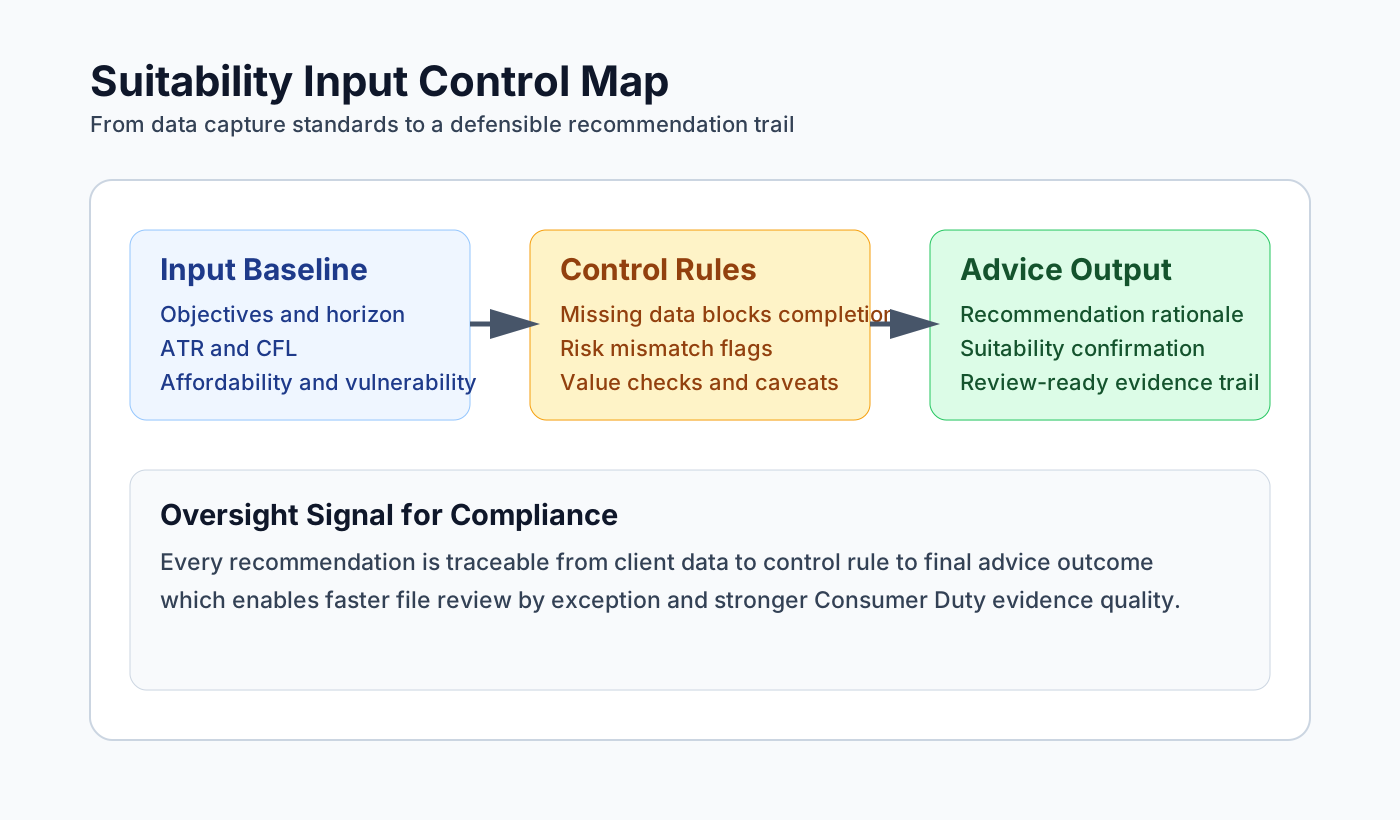
Completeness gates create hard stops at defined points in the workflow. A fact-find cannot be marked as complete until all mandatory sections are populated. A risk assessment cannot be started until the fact-find is complete. A suitability report cannot be generated until the risk assessment is finished. Each gate ensures that downstream work is built on a complete foundation. The 33% of files with missing information becomes structurally impossible because the process will not allow progression without the data.
Contradiction flags highlight changes between fact-find versions. When a client's income need changes from £25,000 to £30,000, the system flags the change and requires the adviser to record a reason. This creates the audit trail the FCA expects: not just what the data is, but why it changed. Client-facing portals allow pre-meeting data collection, where clients complete sections of the fact-find directly. This improves data quality — clients have access to their own records and can provide accurate figures — while reducing meeting time spent on administrative data gathering.
From data collection to evidence
The fact-find is not just a data collection exercise. It is the foundation of the suitability evidence chain. Every field in a well-designed fact-find maps to a specific requirement in COBS 9.2: financial situation (9.2.2R(1)), investment objectives (9.2.2R(2)), knowledge and experience (9.2.2R(3)). When the fact-find is incomplete, the evidence chain is broken before it begins.
In a structured system, the data collected in the fact-find flows directly into the risk assessment, the cashflow model, and the suitability report. Income needs captured in the fact-find become the income target in the cashflow projection. Health information feeds longevity assumptions. State pension timing offsets drawdown income requirements. There is no re-keying, no manual transfer of data between tools, and no opportunity for transcription errors.
This creates an automatic evidence chain from client data to recommendation. The suitability report can reference specific fact-find data with confidence that the numbers match. QA reviewers can verify that the recommendation follows from the data without manually checking that figures were correctly transferred between documents. And when the FCA reviews the file, the evidence is complete, consistent, and traceable from first data point to final recommendation. That is what suitability evidence should look like.